







Complex Down-Conversion Amplitude Loss
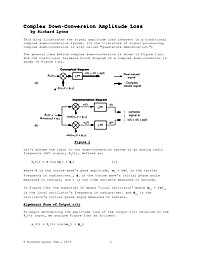
This article illustrates the signal amplitude loss inherent in a traditional complex down-conversion system. (In the literature of signal processing, complex down-conversion is also called "quadrature demodulation.")
Summary
This paper demonstrates the signal amplitude loss that occurs in traditional complex down-conversion (quadrature demodulation) systems. It guides the reader through the mathematical origin of the loss, measurement approaches, and practical implications for receiver and signal-processing designs.
Key Takeaways
- Explain how amplitude loss arises from ideal quadrature demodulation and non-ideal I/Q implementation effects
- Quantify amplitude loss with closed-form expressions and example calculations for common down-conversion architectures
- Demonstrate measurement techniques (using spectral analysis/FFT) to observe and estimate the loss in real systems
- Recommend practical mitigation strategies such as calibration, phase correction, and filter/scale adjustments
Who Should Read This
DSP, RF, and communications engineers with hands-on receiver or SDR design responsibilities who need to understand, measure, and compensate amplitude errors from complex down-conversion.
TimelessIntermediate
Related Documents
- A New Approach to Linear Filtering and Prediction Problems TimelessAdvanced
- A Quadrature Signals Tutorial: Complex, But Not Complicated TimelessIntermediate
- An Introduction To Compressive Sampling TimelessIntermediate
- Lecture Notes on Elliptic Filter Design TimelessAdvanced
- Computing FFT Twiddle Factors TimelessAdvanced










