







A New Contender in the Digital Differentiator Race
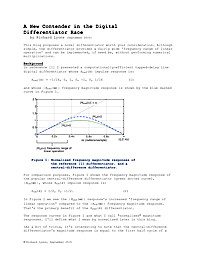
This blog proposes a novel differentiator worth your consideration. Although simple, the differentiator provides a fairly wide 'frequency range of linear operation' and can be implemented, if need be, without performing numerical multiplications.
Summary
This article by Rick Lyons introduces a compact digital differentiator that delivers a relatively wide frequency range of linear operation while remaining simple to analyze and implement. Readers will learn the differentiator's design, frequency-response characteristics, and practical implementation options — including a multiplier-free realization suitable for resource-constrained or real-time systems.
Key Takeaways
- Evaluate the differentiator's frequency-response and quantify its linear operating band versus conventional FIR/IIR differentiators
- Implement the differentiator using only additions, delays, and sign changes to avoid numerical multiplications where required
- Compare trade-offs in noise sensitivity, phase linearity, and computational cost against standard discrete differentiator designs
- Integrate the differentiator into real-time DSP or control loops and assess stability and latency impacts
Who Should Read This
Intermediate-to-advanced DSP and control engineers interested in compact, low-cost differentiator designs for real-time systems and embedded implementations.
Still RelevantAdvanced
Related Documents
- A New Approach to Linear Filtering and Prediction Problems TimelessAdvanced
- Lecture Notes on Elliptic Filter Design TimelessAdvanced
- Computing FFT Twiddle Factors TimelessAdvanced
- Digital Envelope Detection: The Good, the Bad, and the Ugly TimelessIntermediate
- The World's Most Interesting FIR Filter Equation: Why FIR Filters Can Be Line... TimelessAdvanced










