Stereophonic Amplitude-Panning: A Derivation of the "Tangent Law"
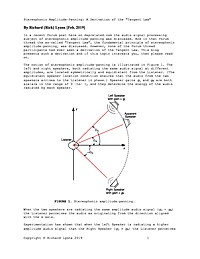
This article presents a derivation of the "Tangent Law"
Summary
This blog article derives the stereophonic amplitude-panning "Tangent Law", showing how left/right amplitude ratios map to perceived source angle. It explains the mathematical steps, assumptions, and practical implications for designing stereo panning controls and spatial-audio processing.
Key Takeaways
- Derive the tangent-law relationship linking amplitude ratio to perceived stereo angle
- Compute left/right gain values for a desired panned angle using the derived formulas
- Identify the assumptions and limitations (listener position, interaural cues, and loudness effects) that affect panning accuracy
- Implement and validate the panning law in a DSP workflow or MATLAB/Simulink prototype
Who Should Read This
Intermediate audio engineers, DSP practitioners, and researchers who design stereo panning, spatial-audio tools, or mixing controls and want a clear mathematical derivation and practical guidance.
TimelessIntermediate
Related Documents
- A Quadrature Signals Tutorial: Complex, But Not Complicated TimelessIntermediate
- Computing FFT Twiddle Factors TimelessAdvanced
- Digital Envelope Detection: The Good, the Bad, and the Ugly TimelessIntermediate
- The World's Most Interesting FIR Filter Equation: Why FIR Filters Can Be Line... TimelessAdvanced
- Multirate Systems and Filter Banks TimelessAdvanced