







Add the Hilbert Transformer to Your DSP Toolkit, Part 2
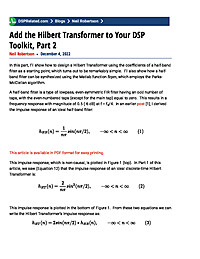
In this part, I’ll show how to design a Hilbert Transformer using the coefficients of a half-band filter as a starting point, which turns out to be remarkably simple. I’ll also show how a half-band filter can be synthesized using the...

Summary
This blog shows a practical method to design a Hilbert transformer by starting from the coefficients of a half-band filter, explaining why the approach is simple and effective. It also walks through synthesizing a half-band FIR filter and verifying the quadrature (90°) response using spectral analysis techniques.
Key Takeaways
- Use half-band FIR coefficients as a straightforward starting point to construct a Hilbert transformer with odd-symmetric impulse response.
- Design and synthesize a linear-phase half-band FIR filter tailored for Hilbert-transform construction.
- Verify the transformer’s phase (90°) and amplitude behavior using FFT-based spectral analysis and error metrics.
- Exploit filter symmetry and coefficient structure to implement an efficient FIR realization with reduced computation.
Who Should Read This
Intermediate DSP engineers and practitioners (audio, communications, radar) who need a practical, implementable method to build Hilbert transformers from half-band FIR filters.
Still RelevantIntermediate
Related Documents
- A Quadrature Signals Tutorial: Complex, But Not Complicated TimelessIntermediate
- Lecture Notes on Elliptic Filter Design TimelessAdvanced
- Computing FFT Twiddle Factors TimelessAdvanced
- Digital Envelope Detection: The Good, the Bad, and the Ugly TimelessIntermediate
- The World's Most Interesting FIR Filter Equation: Why FIR Filters Can Be Line... TimelessAdvanced









