Digital Waveguide Model
![\includegraphics[scale=0.9]{eps/fideal}](http://www.dsprelated.com/josimages_new/pasp/img3287.png) |
 . (The symbol
``
. (The symbol
`` '' denotes a one-sample delay.)
In this section, we interpret the sampled d'Alembert traveling-wave solution of the ideal wave equation as a digital filtering framework. This is an example of what are generally known as digital waveguide models [430,431,433,437,442].
The term
![$ y_r\left[(n-m)T\right]\isdef y^{+}(n-m)$](http://www.dsprelated.com/josimages_new/pasp/img3288.png) in Eq.
in Eq. (C.16) can
be thought of as the output of an
(C.16) can
be thought of as the output of an  -sample delay line whose input is
 . In general, subtracting a positive number from a time
argument
. In general, subtracting a positive number from a time
argument  corresponds to delaying the waveform by
samples. Since
corresponds to delaying the waveform by
samples. Since  is the right-going component, we draw its delay
line with input on the left and its output
is the right-going component, we draw its delay
line with input on the left and its output
 on the
right. This can be seen as the upper ``rail'' in Fig.C.3
on the
right. This can be seen as the upper ``rail'' in Fig.C.3
Similarly, the term
![$ y_l\left[(n+m)T\right]\isdeftext y^{-}(n+m)$](http://www.dsprelated.com/josimages_new/pasp/img3290.png) can be
thought of as the input to an -sample delay line whose
output is
can be
thought of as the input to an -sample delay line whose
output is  . Adding to the time argument
produces an -sample waveform
advance. Since
. Adding to the time argument
produces an -sample waveform
advance. Since  is the left-going component, it makes
sense to draw the delay line with its input
is the left-going component, it makes
sense to draw the delay line with its input
 on the right
and its output on the left.
This can be seen as the lower ``rail'' in Fig.C.3.
on the right
and its output on the left.
This can be seen as the lower ``rail'' in Fig.C.3.
Note that the position along the string,
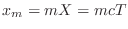 meters,
is laid out from left to right in the diagram, giving a physical
interpretation to the horizontal direction in the diagram. Finally,
the left- and right-going traveling waves must be summed to produce a
physical output according to the formula
meters,
is laid out from left to right in the diagram, giving a physical
interpretation to the horizontal direction in the diagram. Finally,
the left- and right-going traveling waves must be summed to produce a
physical output according to the formula

We may compute the physical string displacement at any spatial sampling point
 by simply adding the upper and lower rails together at position
along the delay-line pair. In Fig.C.3, ``transverse
displacement outputs'' have been arbitrarily placed at
by simply adding the upper and lower rails together at position
along the delay-line pair. In Fig.C.3, ``transverse
displacement outputs'' have been arbitrarily placed at  and
and  .
The diagram is similar to that of well known ladder and lattice digital
filter structures (§C.9.4,[297]),
except for the delays along the upper rail,
the absence of scattering junctions, and the direct physical
interpretation. (A scattering junction implements partial reflection and
partial transmission in the waveguide.) We could proceed to ladder and
lattice filters by (1) introducing a perfectly reflecting (rigid or free)
termination at the far right, and (2) commuting the delays rightward from
the upper rail down to the lower rail [432,434]. The absence of
scattering junctions is due to the fact that the string has a uniform wave
impedance. In acoustic tube simulations, such as for voice
[87,297] or wind instruments [195], lossless scattering
junctions are used at changes in cross-sectional tube area and lossy
scattering junctions are used to implement tone holes. In waveguide
bowed-string synthesis (discussed in a later section), the bow itself
creates an active, time-varying, and nonlinear scattering junction on the
string at the bowing point.
.
The diagram is similar to that of well known ladder and lattice digital
filter structures (§C.9.4,[297]),
except for the delays along the upper rail,
the absence of scattering junctions, and the direct physical
interpretation. (A scattering junction implements partial reflection and
partial transmission in the waveguide.) We could proceed to ladder and
lattice filters by (1) introducing a perfectly reflecting (rigid or free)
termination at the far right, and (2) commuting the delays rightward from
the upper rail down to the lower rail [432,434]. The absence of
scattering junctions is due to the fact that the string has a uniform wave
impedance. In acoustic tube simulations, such as for voice
[87,297] or wind instruments [195], lossless scattering
junctions are used at changes in cross-sectional tube area and lossy
scattering junctions are used to implement tone holes. In waveguide
bowed-string synthesis (discussed in a later section), the bow itself
creates an active, time-varying, and nonlinear scattering junction on the
string at the bowing point.
Any ideal, one-dimensional waveguide can be simulated in this way. It
is important to note that the simulation is exact at the
sampling instants, to within the numerical precision of the samples
themselves. To avoid aliasing associated with sampling, we
require all waveshapes traveling along the string to be initially
bandlimited to less than half the sampling frequency. In other
words, the highest frequencies present in the signals  and
and
 may not exceed half the temporal sampling frequency
 ; equivalently, the highest spatial
frequencies in the shapes
; equivalently, the highest spatial
frequencies in the shapes  and
and  may not exceed
half the spatial sampling frequency
may not exceed
half the spatial sampling frequency
 .
.
A C program implementing a plucked/struck string model in the form of Fig.C.3 is available at http://ccrma.stanford.edu/~jos/pmudw/.
Next Section:
Digital Waveguide Interpolation
Previous Section:
Converting Any String State to Traveling Slope-Wave Components