







Tonehole Filter Design
The tone-hole reflectance and transmittance must be converted to
discrete-time form for implementation in a digital waveguide model.
Figure 9.49 plots the responses of second-order discrete-time
filters designed to approximate the continuous-time magnitude and phase
characteristics of the reflectances for closed and open toneholes, as
carried out in [403,406]. These filter designs
assumed a tonehole of radius  mm, minimum tonehole height
 mm, tonehole radius of curvature
 mm, and air column
radius
mm, and air column
radius  mm. Since the measurements of Keefe do not extend to 5
kHz, the continuous-time responses in the figures are extrapolated above
this limit. Correspondingly, the filter designs were weighted to produce
best results below 5 kHz.
mm. Since the measurements of Keefe do not extend to 5
kHz, the continuous-time responses in the figures are extrapolated above
this limit. Correspondingly, the filter designs were weighted to produce
best results below 5 kHz.
The closed-hole filter design was carried out using weighted  equation-error minimization [428, p. 47], i.e., by minimizing
![$ \vert\vert\,W(e^{j\omega})[{\hat A}(e^{j\omega})H(e^{j\omega}) - {\hat B}(e^{j\omega})]\,\vert\vert _2$](http://www.dsprelated.com/josimages_new/pasp/img2504.png) , where
, where  is the weighting
function,
is the weighting
function,
 is the desired frequency response,
  denotes
discrete-time radian frequency, and the designed filter response is
denotes
discrete-time radian frequency, and the designed filter response is
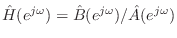 . Note that both phase and magnitude are
matched by equation-error minimization, and this error criterion is used
extensively in the field of system identification [288]
due to its ability to design optimal IIR filters via quadratic
minimization. In the spirit of the well-known Steiglitz-McBride algorithm
[287], equation-error minimization can be iterated,
setting the weighting function at iteration
. Note that both phase and magnitude are
matched by equation-error minimization, and this error criterion is used
extensively in the field of system identification [288]
due to its ability to design optimal IIR filters via quadratic
minimization. In the spirit of the well-known Steiglitz-McBride algorithm
[287], equation-error minimization can be iterated,
setting the weighting function at iteration  to the inverse of the
inherent weighting
to the inverse of the
inherent weighting
 of the previous iteration, i.e.,
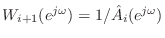 . However, for this study, the weighting was used only to
increase accuracy at low frequencies relative to high frequencies.
Weighted equation-error minimization is implemented in the matlab function
invfreqz() (§8.6.4).
. However, for this study, the weighting was used only to
increase accuracy at low frequencies relative to high frequencies.
Weighted equation-error minimization is implemented in the matlab function
invfreqz() (§8.6.4).
The open-hole discrete-time filter was designed using Kopec's method [297], [428, p. 46] in conjunction with weighted equation-error minimization. Kopec's method is based on linear prediction:
- Given a desired complex frequency response
, compute an
allpole model
 using linear prediction
- Compute the error spectrum
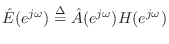 .
.
- Compute an allpole model
 for
for
 by
minimizing
by
minimizing

ratio error
 ratio-error norm. Thus, in Kopec's method, the poles model the upper
spectral envelope, while the zeros model the lower spectral envelope.
To apply Kopec's method to the design of an open-tonehole filter, a
one-pole model
ratio-error norm. Thus, in Kopec's method, the poles model the upper
spectral envelope, while the zeros model the lower spectral envelope.
To apply Kopec's method to the design of an open-tonehole filter, a
one-pole model
 was first fit to the continuous-time
response,
was first fit to the continuous-time
response,
 Subsequently, the inverse error spectrum,
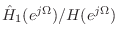 was modeled with a two-pole
digital filter,
was modeled with a two-pole
digital filter,
 The discrete-time approximation to
 was then given by

![\includegraphics[width=\twidth]{eps/twoptfilts}](http://www.dsprelated.com/josimages_new/pasp/img2522.png) |
 kHz.
The open tonehole has one anti-resonance in the audio band near
kHz.
The open tonehole has one anti-resonance in the audio band near  kHz.
At
kHz.
At The reasonably close match in both phase and magnitude by second-order filters indicates that there is in fact only one important tonehole resonance and/or anti-resonance within the audio band, and that the measured frequency responses can be modeled with very high audio accuracy using only second-order filters.
Figure 9.50 plots the reflection function calculated for a six-hole flute bore, as described in [240].
![\includegraphics[width=\twidth]{eps/gtwoport}](http://www.dsprelated.com/josimages_new/pasp/img2523.png) |
 (three finger holes closed, three finger holes open) on a simple flute (from [
Next Section:
The Tonehole as a Two-Port Loaded Junction
Previous Section:
The Clarinet Tonehole as a Two-Port Junction












