DC Blocker
The dc blocker is an indispensable tool in digital waveguide modeling [86] and other applications.B.4 It is often needed to remove the dc component of the signal circulating in a delay-line loop. It is also often an important tool in multi-track recording, where dc components in the various tracks can add up and overflow the mix.
The dc blocker is a small recursive filter specified by the difference equation

 is a parameter that is typically somewhere between
  and
and  (for a 44.1 kHz sampling rate,
  is good).
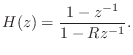
The transfer function is
is good).
The transfer function is
Thus, there is a zero at dc (
 ) and a pole near dc at
  . Far
away from dc, the pole and zero approximately cancel each other.
(Recall the graphical method for determining frequency response
magnitude described in Chapter 8.)
. Far
away from dc, the pole and zero approximately cancel each other.
(Recall the graphical method for determining frequency response
magnitude described in Chapter 8.)
DC Blocker Frequency Response
Figure B.11 shows the frequency response of the dc blocker
for several values of . The same plots are given over a
log-frequency scale in Fig.B.12. The corresponding
pole-zero diagrams are shown in Fig.B.13. As approaches
, the notch at dc gets narrower and narrower. While this may seem
ideal, there is a drawback, as shown in Fig.B.14 for the
case of  : The impulse response duration increases as
  .
While the ``tail'' of the impulse response lengthens as approaches
1, its initial magnitude decreases. At the limit,
.
While the ``tail'' of the impulse response lengthens as approaches
1, its initial magnitude decreases. At the limit,  , the pole and
zero cancel at all frequencies, the impulse response becomes an
impulse, and the notch disappears.
, the pole and
zero cancel at all frequencies, the impulse response becomes an
impulse, and the notch disappears.
![\includegraphics[width=\twidth ]{eps/dcblockerfr}](http://www.dsprelated.com/josimages_new/filters/img1459.png) |
 for various values of
![\includegraphics[width=\twidth ]{eps/dcblockerfrlf}](http://www.dsprelated.com/josimages_new/filters/img1460.png) |
![\includegraphics[width=\twidth]{eps/dcblockerpz}](http://www.dsprelated.com/josimages_new/filters/img1461.png) |
 .
.![\includegraphics[width=\twidth ]{eps/dcblockerir}](http://www.dsprelated.com/josimages_new/filters/img1462.png)
Note that the amplitude response in Fig.B.11a and
Fig.B.12a exceeds 1 at half the sampling rate.
This maximum gain is given by
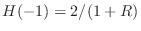 . In applications for
which the gain must be bounded by 1 at all frequencies, the dc blocker
may be scaled by the inverse of this maximum gain to yield
. In applications for
which the gain must be bounded by 1 at all frequencies, the dc blocker
may be scaled by the inverse of this maximum gain to yield
![\begin{eqnarray*}
H(z) &=& g\frac{1-z^{-1}}{1-Rz^{-1}}\\
y(n) &=& g[x(n) - x(n-1)] + R\, y(n-1), \quad\hbox{where}\\
g &\isdef & \frac{1+R}{2}.
\end{eqnarray*}](http://www.dsprelated.com/josimages_new/filters/img1464.png)
DC Blocker Software Implementations
In plain C, the difference equation for the dc blocker could be written as follows:
  y = x - xm1 + 0.995 * ym1;
  xm1 = x;
  ym1 = y;
Here, x denotes the current input sample, and y denotes the current output sample. The variables xm1 and ym1 hold once-delayed input and output samples, respectively (and are typically initialized to zero). In this implementation, the pole is fixed at
, which corresponds
to an adaptation time-constant of approximately
 samples. A smaller value allows faster tracking of ``wandering dc
levels'', but at the cost of greater low-frequency attenuation.
samples. A smaller value allows faster tracking of ``wandering dc
levels'', but at the cost of greater low-frequency attenuation.
A complete C++ class implementing a dc blocking filter is included in the free, open-source Synthesis Tool Kit (STK) [15]. (See the DCBlock STK class.)
For a discussion of issues and solutions related to fixed-point implementations, see [7].
Next Section:
Low and High Shelving Filters
Previous Section:
Allpass Filter Sections