







Higher Order Terms
The complete, linear, time-invariant generalization of the lossy, stiff string is described by the differential equation
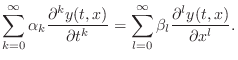
which, on setting
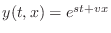 , (or taking the 2D Laplace transform
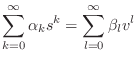
with zero initial conditions), yields the algebraic equation,
, (or taking the 2D Laplace transform
with zero initial conditions), yields the algebraic equation,
 |
(C.34) |
Solving for
 in terms of
  is, of course, nontrivial in general.
However, in specific cases, we can determine the appropriate
attenuation per sample
is, of course, nontrivial in general.
However, in specific cases, we can determine the appropriate
attenuation per sample  and wave propagation speed
 by numerical means. For example, starting at
  , we
normally also have
, we
normally also have  (corresponding to the absence of static
deformation in the medium). Stepping forward by a small
differential
(corresponding to the absence of static
deformation in the medium). Stepping forward by a small
differential
 , the left-hand side can be approximated by
 . Requiring the generalized wave velocity
 to be continuous, a physically reasonable assumption, the
right-hand side can be approximated by
to be continuous, a physically reasonable assumption, the
right-hand side can be approximated by
 , and
the solution is easy. As steps forward, higher order terms become
important one by one on both sides of the equation. Each new term in
spawns a new solution for in terms of , since the order of
the polynomial in is incremented. It appears possible that
homotopy continuation methods [316] can be used to
keep track of the branching solutions of as a function of .
For each solution
, and
the solution is easy. As steps forward, higher order terms become
important one by one on both sides of the equation. Each new term in
spawns a new solution for in terms of , since the order of
the polynomial in is incremented. It appears possible that
homotopy continuation methods [316] can be used to
keep track of the branching solutions of as a function of .
For each solution  , let
, let
 denote the real part of
 and let
 denote the imaginary part. Then the
eigensolution family can be seen in the form
denote the imaginary part. Then the
eigensolution family can be seen in the form
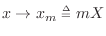
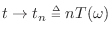
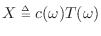
 . Defining
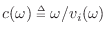 , and
sampling according to
, and
sampling according to
 and
and
 , with
 as before, (the spatial sampling
period is taken to be frequency invariant, while the temporal sampling
interval is modulated versus frequency using allpass filters), the
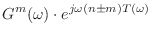
left- and right-going sampled eigensolutions become
as before, (the spatial sampling
period is taken to be frequency invariant, while the temporal sampling
interval is modulated versus frequency using allpass filters), the
left- and right-going sampled eigensolutions become
 |
 |
 |
(C.35) |
|
 |
where
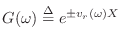 . Thus, a general map of
versus , corresponding to a partial differential equation of any
order in the form (C.33), can be translated, in principle, into an
accurate, local, linear, time-invariant, discrete-time simulation.
The boundary conditions and initial state determine the initial
mixture of the various solution branches as usual.
. Thus, a general map of
versus , corresponding to a partial differential equation of any
order in the form (C.33), can be translated, in principle, into an
accurate, local, linear, time-invariant, discrete-time simulation.
The boundary conditions and initial state determine the initial
mixture of the various solution branches as usual.
We see that a large class of wave equations with constant coefficients, of any order, admits a decaying, dispersive, traveling-wave type solution. Even-order time derivatives give rise to frequency-dependent dispersion and odd-order time derivatives correspond to frequency-dependent losses. The corresponding digital simulation of an arbitrarily long (undriven and unobserved) section of medium can be simplified via commutativity to at most two pure delays and at most two linear, time-invariant filters.
Every linear, time-invariant filter can be expressed as a zero-phase filter in series with an allpass filter. The zero-phase part can be interpreted as implementing a frequency-dependent gain (damping in a digital waveguide), and the allpass part can be seen as frequency-dependent delay (dispersion in a digital waveguide).
Next Section:
Spatial Derivatives
Previous Section:
Lossy Finite Difference Recursion












