Incorporating Control Motion
Let  denote the vertical position of the mass
in Fig.9.22. (We still assume
denote the vertical position of the mass
in Fig.9.22. (We still assume  .) We can think of
 as the position of the control point on the
plectrum, e.g., the position of the ``pinch-point'' holding the
plectrum while plucking the string. In a harpsichord, can be
considered the jack position [347].
as the position of the control point on the
plectrum, e.g., the position of the ``pinch-point'' holding the
plectrum while plucking the string. In a harpsichord, can be
considered the jack position [347].
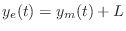
Also denote by  the rest length of the spring
  in Fig.9.22, and let
 denote the
position of the ``end'' of the spring while not in contact with the
string. Then the plectrum makes contact with the string when
denote the
position of the ``end'' of the spring while not in contact with the
string. Then the plectrum makes contact with the string when

 denotes string vertical position at the plucking point
 . This may be called the collision detection equation.
Let the subscripts  and
and  each denote one side of the scattering
system, as indicated in Fig.9.23. Then, for example,
each denote one side of the scattering
system, as indicated in Fig.9.23. Then, for example,
 is the displacement of the string on the left (side
) of plucking point, and
is the displacement of the string on the left (side
) of plucking point, and  is on the right side of (but
still located at point ). By continuity of the string, we have
is on the right side of (but
still located at point ). By continuity of the string, we have

When the spring engages the string ( ) and begins to compress,
the upward force on the string at the contact point is given by
) and begins to compress,
the upward force on the string at the contact point is given by
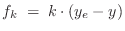
 . The force
  is applied given
  (spring is in contact with string) and given
 (the force
at which the pluck releases in a simple max-force
model).10.15 For
(the force
at which the pluck releases in a simple max-force
model).10.15 For  or
or
 the applied force is zero and the entire
plucking system disappears to leave
the applied force is zero and the entire
plucking system disappears to leave
 and
and
 ,
or equivalently, the force reflectance becomes
,
or equivalently, the force reflectance becomes
 and the
transmittance becomes
and the
transmittance becomes
 .
.
During contact, force equilibrium at the plucking point requires (cf. §9.3.1)
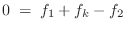
where
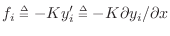 as usual (§6.1), with
  denoting the string tension.
Using Ohm's laws for traveling-wave components (p.
denoting the string tension.
Using Ohm's laws for traveling-wave components (p. ![[*]](../icons/crossref.png) ), we
have
), we
have

 denotes the string wave impedance
(p. ). Solving Eq.
denotes the string wave impedance
(p. ). Solving Eq. (9.25) for the velocity at the
plucking point yields
(9.25) for the velocity at the
plucking point yields
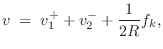
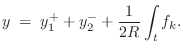
Substituting
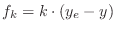 and taking the Laplace transform yields
![$\displaystyle Y(s)
\eqsp Y_1^+(s) + Y_2^-(s) + \frac{1}{2R} \frac{F_k(s)}{s}
\eqsp Y_1^+(s) + Y_2^-(s) + \frac{k}{2Rs}\left[Y_e(s) - Y(s)\right].
$](http://www.dsprelated.com/josimages_new/pasp/img2224.png)
 and recognizing the force reflectance
 gives
gives
![\begin{eqnarray*}
Y(s) &=& \left[1-\hat{\rho}_f(s)\right]\cdot
\left[Y_1^+(s)+Y...
...)\cdot \left\{Y_e(s)
- \left[Y_1^+(s)+Y_2^-(s)\right]\right\},
\end{eqnarray*}](http://www.dsprelated.com/josimages_new/pasp/img2226.png)
where, as first noted at Eq.(9.24) above,

![\begin{eqnarray*}
Y_d^+ &=& Y_e - \left(Y_1^+ + Y_2^-\right)\\ [5pt]
Y_1^- &=& Y...
...\hat{\rho}_f Y_d^+\\ [5pt]
Y_2^+ &=& Y_1^+ + \hat{\rho}_f Y_d^+.
\end{eqnarray*}](http://www.dsprelated.com/josimages_new/pasp/img2228.png)
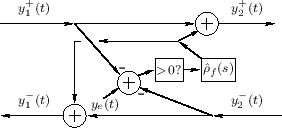
This system is diagrammed in Fig.9.24. The manipulation of the
minus signs relative to Fig.9.23 makes it convenient for
restricting  to positive values only (as shown in the
figure), corresponding to the plectrum engaging the string going up.
This uses the approximation
to positive values only (as shown in the
figure), corresponding to the plectrum engaging the string going up.
This uses the approximation
 ,
which is exact when
, i.e., when the plectrum does not affect
the string displacement at the current time. It is therefore exact at
the time of collision and also applicable just after release.
Similarly,
,
which is exact when
, i.e., when the plectrum does not affect
the string displacement at the current time. It is therefore exact at
the time of collision and also applicable just after release.
Similarly,
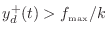 can be used to trigger a release of the
string from the plectrum.
can be used to trigger a release of the
string from the plectrum.
 .
.
Next Section:
Successive Pluck Collision Detection
Previous Section:
Digital Waveguide Plucked-String Model