







Pluck Modeling
The piano-hammer model of the previous section can also be configured
as a plectrum by making the mass and damping small or zero, and
by releasing the string when the contact force exceeds some threshold
 . That is, to a first approximation, a plectrum can be modeled
as a spring (linear or nonlinear) that disengages when either
it is far from the string or a maximum spring-force is exceeded. To
avoid discontinuities when the plectrum and string engage/disengage,
it is good to taper both the damping and spring-constant to zero at
the point of contact (as shown
below).
. That is, to a first approximation, a plectrum can be modeled
as a spring (linear or nonlinear) that disengages when either
it is far from the string or a maximum spring-force is exceeded. To
avoid discontinuities when the plectrum and string engage/disengage,
it is good to taper both the damping and spring-constant to zero at
the point of contact (as shown
below).
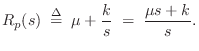
Starting with the piano-hammer impedance of Eq. (9.19) and setting
the mass
(9.19) and setting
the mass  to infinity (the plectrum holder is immovable), we define
the plectrum impedance as
to infinity (the plectrum holder is immovable), we define
the plectrum impedance as
The force-wave reflectance of impedance  in Eq.(9.22), as
seen from the string, may be computed exactly as in
§9.3.1:
in Eq.(9.22), as
seen from the string, may be computed exactly as in
§9.3.1:


![$\displaystyle \frac{\mbox{Impedance Step}}{\mbox{Impedance Sum}}
\eqsp \frac{[R_p(s)+R]-R}{[R_p(s)+R]+R}
\eqsp \frac{R_p(s)}{R_p(s)+2R}$](http://www.dsprelated.com/josimages_new/pasp/img2187.png)
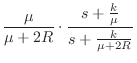
If the spring damping is much greater than twice the string wave impedance (
 ), then the plectrum looks like a rigid
termination to the string (force reflectance
), then the plectrum looks like a rigid
termination to the string (force reflectance
 ), which
makes physical sense.
), which
makes physical sense.
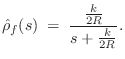
Again following §9.3.1, the transmittance for force waves is given by
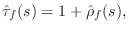
 and
and
 .
.
If the damping  is set to zero, i.e., if the plectrum is to be modeled
as a simple linear spring, then the impedance becomes
is set to zero, i.e., if the plectrum is to be modeled
as a simple linear spring, then the impedance becomes
 ,
and the force-wave reflectance becomes
[128]
,
and the force-wave reflectance becomes
[128]
Digital Waveguide Plucked-String Model
When plucking a string, it is necessary to detect ``collisions''
between the plectrum and string. Also, more complete plucked-string
models will allow the string to ``buzz'' on the frets and ``slap''
against obstacles such as the fingerboard. For these reasons, it is
convenient to choose displacement waves for the waveguide
string model. The reflection and transmission filters for
displacement waves are the same as for velocity, namely,
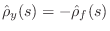 and
and
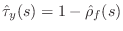 .
.
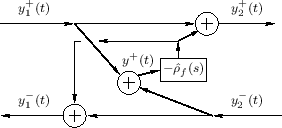
As in the mass-string collision case, we obtain the one-filter
scattering-junction implementation shown in Fig.9.23. The filter
 may now be digitized using the bilinear transform as
previously (§9.3.1).
may now be digitized using the bilinear transform as
previously (§9.3.1).
Incorporating Control Motion
Let  denote the vertical position of the mass
in Fig.9.22. (We still assume
denote the vertical position of the mass
in Fig.9.22. (We still assume  .) We can think of
 as the position of the control point on the
plectrum, e.g., the position of the ``pinch-point'' holding the
plectrum while plucking the string. In a harpsichord, can be
considered the jack position [347].
as the position of the control point on the
plectrum, e.g., the position of the ``pinch-point'' holding the
plectrum while plucking the string. In a harpsichord, can be
considered the jack position [347].
Also denote by  the rest length of the spring
  in Fig.9.22, and let
 denote the
position of the ``end'' of the spring while not in contact with the
string. Then the plectrum makes contact with the string when
denote the
position of the ``end'' of the spring while not in contact with the
string. Then the plectrum makes contact with the string when

 denotes string vertical position at the plucking point
 . This may be called the collision detection equation.
Let the subscripts  and
and  each denote one side of the scattering
system, as indicated in Fig.9.23. Then, for example,
each denote one side of the scattering
system, as indicated in Fig.9.23. Then, for example,
 is the displacement of the string on the left (side
) of plucking point, and
is the displacement of the string on the left (side
) of plucking point, and  is on the right side of (but
still located at point ). By continuity of the string, we have
is on the right side of (but
still located at point ). By continuity of the string, we have

When the spring engages the string ( ) and begins to compress,
the upward force on the string at the contact point is given by
) and begins to compress,
the upward force on the string at the contact point is given by
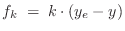
 . The force
  is applied given
  (spring is in contact with string) and given
 (the force
at which the pluck releases in a simple max-force
model).10.15 For
(the force
at which the pluck releases in a simple max-force
model).10.15 For  or
or
 the applied force is zero and the entire
plucking system disappears to leave
the applied force is zero and the entire
plucking system disappears to leave
 and
and
 ,
or equivalently, the force reflectance becomes
,
or equivalently, the force reflectance becomes
 and the
transmittance becomes
and the
transmittance becomes
 .
.
During contact, force equilibrium at the plucking point requires (cf. §9.3.1)
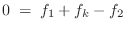
where
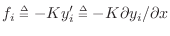 as usual (§6.1), with
  denoting the string tension.
Using Ohm's laws for traveling-wave components (p.
denoting the string tension.
Using Ohm's laws for traveling-wave components (p. ![[*]](../icons/crossref.png) ), we
have
), we
have

 denotes the string wave impedance
(p. ). Solving Eq.(9.25) for the velocity at the
plucking point yields
denotes the string wave impedance
(p. ). Solving Eq.(9.25) for the velocity at the
plucking point yields
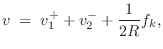
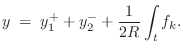
Substituting
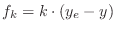 and taking the Laplace transform yields
![$\displaystyle Y(s)
\eqsp Y_1^+(s) + Y_2^-(s) + \frac{1}{2R} \frac{F_k(s)}{s}
\eqsp Y_1^+(s) + Y_2^-(s) + \frac{k}{2Rs}\left[Y_e(s) - Y(s)\right].
$](http://www.dsprelated.com/josimages_new/pasp/img2224.png)
 and recognizing the force reflectance
gives
and recognizing the force reflectance
gives
![\begin{eqnarray*}
Y(s) &=& \left[1-\hat{\rho}_f(s)\right]\cdot
\left[Y_1^+(s)+Y...
...)\cdot \left\{Y_e(s)
- \left[Y_1^+(s)+Y_2^-(s)\right]\right\},
\end{eqnarray*}](http://www.dsprelated.com/josimages_new/pasp/img2226.png)
where, as first noted at Eq.(9.24) above,

![\begin{eqnarray*}
Y_d^+ &=& Y_e - \left(Y_1^+ + Y_2^-\right)\\ [5pt]
Y_1^- &=& Y...
...\hat{\rho}_f Y_d^+\\ [5pt]
Y_2^+ &=& Y_1^+ + \hat{\rho}_f Y_d^+.
\end{eqnarray*}](http://www.dsprelated.com/josimages_new/pasp/img2228.png)
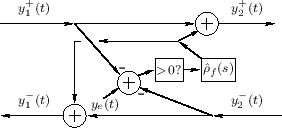
This system is diagrammed in Fig.9.24. The manipulation of the
minus signs relative to Fig.9.23 makes it convenient for
restricting  to positive values only (as shown in the
figure), corresponding to the plectrum engaging the string going up.
This uses the approximation
to positive values only (as shown in the
figure), corresponding to the plectrum engaging the string going up.
This uses the approximation
 ,
which is exact when
, i.e., when the plectrum does not affect
the string displacement at the current time. It is therefore exact at
the time of collision and also applicable just after release.
Similarly,
,
which is exact when
, i.e., when the plectrum does not affect
the string displacement at the current time. It is therefore exact at
the time of collision and also applicable just after release.
Similarly,
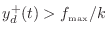 can be used to trigger a release of the
string from the plectrum.
can be used to trigger a release of the
string from the plectrum.
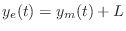 .
.
Successive Pluck Collision Detection
As discussed above, in a simple 1D plucking model, the plectrum comes
up and engages the string when
 , and above some
maximum force the plectrum releases the string. At this point, it is
``above'' the string. To pluck again in the same direction, the
collision-detection must be disabled until we again have ,
requiring one bit of state to keep track of that.10.16 The harpsichord jack
plucks the string only in the ``up'' direction due to its asymmetric
behavior in the two directions [143]. If only
``up picks'' are supported, then engagement can be suppressed after a
release until
, and above some
maximum force the plectrum releases the string. At this point, it is
``above'' the string. To pluck again in the same direction, the
collision-detection must be disabled until we again have ,
requiring one bit of state to keep track of that.10.16 The harpsichord jack
plucks the string only in the ``up'' direction due to its asymmetric
behavior in the two directions [143]. If only
``up picks'' are supported, then engagement can be suppressed after a
release until  comes back down below the envelope of string
vibration (e.g.,
comes back down below the envelope of string
vibration (e.g.,
 ). Note that
intermittent disengagements as a plucking cycle begins are normal;
there is often an audible ``buzzing'' or ``chattering'' when plucking
an already vibrating string.
). Note that
intermittent disengagements as a plucking cycle begins are normal;
there is often an audible ``buzzing'' or ``chattering'' when plucking
an already vibrating string.
When plucking up and down in alternation, as in the tremolo
technique (common on mandolins), the collision detection alternates
between and , and again a bit of state is needed to
keep track of which comparison to use.
Plectrum Damping
To include damping in the plectrum model, the load impedance
 goes back to Eq.(9.22):
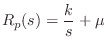 (9.23).
Digitization of the Damped-Spring Plectrum
Applying the bilinear transformation (§7.3.2) to the reflectance
in Eq.(9.23) (including damping) yields the
following first-order digital force-reflectance filter:


 (digital

 (digital zero)
 (gain term)
The transmittance filter is again
 , and there is a
one-filter form for the scattering junction as usual.
, and there is a
one-filter form for the scattering junction as usual.
Feathering
Since the pluck model is linear, the parameters are not signal-dependent. As a result, when the string and spring separate, there is a discontinuous change in the reflection and transmission coefficients. In practice, it is useful to ``feather'' the switch-over from one model to the next [470]. In this instance, one appealing choice is to introduce a nonlinear spring, as is commonly used for piano-hammer models (see §9.3.2 for details).
Let the nonlinear spring model take the form

 corresponds to a linear spring. The spring constant
linearized about zero displacement
corresponds to a linear spring. The spring constant
linearized about zero displacement  is
is

 , approaches zero as
  . In other words, the
spring-constant itself goes to zero with its displacement, instead of
remaining a constant. This behavior serves to ``feather'' contact and
release with the string. We see from Eq.(9.23) above
that, as displacement goes to zero, the reflectance approaches a
frequency-independent reflection coefficient
. In other words, the
spring-constant itself goes to zero with its displacement, instead of
remaining a constant. This behavior serves to ``feather'' contact and
release with the string. We see from Eq.(9.23) above
that, as displacement goes to zero, the reflectance approaches a
frequency-independent reflection coefficient
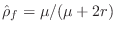 ,
resulting from the damping that remains in the spring model. As
a result, there is still a discontinuity when the spring disengages
from the string.
,
resulting from the damping that remains in the spring model. As
a result, there is still a discontinuity when the spring disengages
from the string.
The foregoing suggests a nonlinear tapering of the damping in
addition to the tapering the stiffness as the spring compression
approaches zero. One natural choice would be

 approaches zero at the same rate as
  . It
would be interesting to estimate
. It
would be interesting to estimate  for the spring and damper from
measured data. In the absence of such data,
for the spring and damper from
measured data. In the absence of such data,  is easy to compute
(requiring a single multiplication). More generally, an interpolated
lookup of
is easy to compute
(requiring a single multiplication). More generally, an interpolated
lookup of  values can be used.
In summary, the engagement and disengagement of the plucking system can be ``feathered'' by a nonlinear spring and damper in the plectrum model.
Next Section:
Stiff Piano Strings
Previous Section:
Piano Hammer Modeling












