Phasing with First-Order Allpass Filters
The block diagram of a typical inexpensive phase shifter for
guitar players is shown in Fig.8.23.9.20 It
consists of a series chain of first-order allpass
filters,9.21 each having a single time-varying parameter  controlling the pole and zero location over time, plus a feedforward
path through gain
controlling the pole and zero location over time, plus a feedforward
path through gain  which is a fixed depth control. Thus,
the delay line of the flanger is replaced by a string of allpass
filters. (A delay line is of course an allpass filter itself.)
which is a fixed depth control. Thus,
the delay line of the flanger is replaced by a string of allpass
filters. (A delay line is of course an allpass filter itself.)
![\includegraphics[width=4.2in]{eps/allpass1phaser}](http://www.dsprelated.com/josimages_new/pasp/img1891.png)
In analog hardware, the first-order allpass transfer function [449, Appendix E, Section 8]9.22is

(In classic phaser circuits such as the Univibe,
 is used, but since there is an even number (four) of allpass stages,
there is no difference.) In discrete time, the general first-order
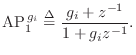
allpass has the transfer function
is used, but since there is an even number (four) of allpass stages,
there is no difference.) In discrete time, the general first-order
allpass has the transfer function
Classic Analog Phase Shifters
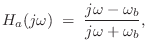
Setting  in Eq.
 (8.19) gives the frequency response
of the analog-phaser transfer function to be
(8.19) gives the frequency response
of the analog-phaser transfer function to be
 ' subscript denotes ``analog'' as opposed to ``digital''.
The phase response is readily found to be
' subscript denotes ``analog'' as opposed to ``digital''.
The phase response is readily found to be
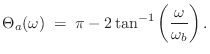
 at dc (
 ), meaning each
allpass section inverts at dc. Also, at
), meaning each
allpass section inverts at dc. Also, at
 (remember
we're talking about analog here), we get a phase of zero. In between,
the phase falls from to 0 as frequency goes from 0 to
(remember
we're talking about analog here), we get a phase of zero. In between,
the phase falls from to 0 as frequency goes from 0 to
 . In particular, at
 , the phase has fallen
exactly half way, to
, the phase has fallen
exactly half way, to  . We will call
the
break frequency of the allpass section.9.23
. We will call
the
break frequency of the allpass section.9.23
Figure 8.24a shows the phase responses of four first-order analog
allpass filters with  set to
![$ 2\pi[100,200,400,800]$](http://www.dsprelated.com/josimages_new/pasp/img1906.png) .
Figure 8.24b shows the resulting normalized amplitude response for
the phaser, for
.
Figure 8.24b shows the resulting normalized amplitude response for
the phaser, for  (unity feedfoward gain). The amplitude response
has also been normalized by dividing by 2 so that the maximum gain is
1. Since there is an even number (four) of allpass sections, the gain
at dc is
(unity feedfoward gain). The amplitude response
has also been normalized by dividing by 2 so that the maximum gain is
1. Since there is an even number (four) of allpass sections, the gain
at dc is
![$ [1+(-1)(-1)(-1)(-1)]/2 = 1$](http://www.dsprelated.com/josimages_new/pasp/img1907.png) . Put another way, the initial
phase of each allpass section at dc is , so that the total
allpass-chain phase at dc is
. Put another way, the initial
phase of each allpass section at dc is , so that the total
allpass-chain phase at dc is  . As frequency increases, the
phase of the allpass chain decreases. When it comes down to
. As frequency increases, the
phase of the allpass chain decreases. When it comes down to  ,
the net effect is a sign inversion by the allpass chain, and the
phaser has a notch. There will be another notch when the phase falls
down to . Thus, four first-order allpass sections give two
notches. For each notch in the desired response we must add two new
first-order allpass sections.
,
the net effect is a sign inversion by the allpass chain, and the
phaser has a notch. There will be another notch when the phase falls
down to . Thus, four first-order allpass sections give two
notches. For each notch in the desired response we must add two new
first-order allpass sections.
![\includegraphics[width=\twidth]{eps/phaser1a}](http://www.dsprelated.com/josimages_new/pasp/img1910.png) |
From Fig.8.24b, we observe that the first notch is near  Hz. This happens to be the frequency at which the first allpass pole
``breaks,'' i.e.,
Hz. This happens to be the frequency at which the first allpass pole
``breaks,'' i.e.,
 . Since the phase of a first-order
allpass section at its break frequency is , the sum of the
other three sections must be approximately
. Since the phase of a first-order
allpass section at its break frequency is , the sum of the
other three sections must be approximately
 .
Equivalently, since the first section has ``given up'' radians
of phase at
.
Equivalently, since the first section has ``given up'' radians
of phase at
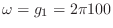 , the other three allpass sections
combined have given up radians as well (with the second
section having given up more than the other two).
, the other three allpass sections
combined have given up radians as well (with the second
section having given up more than the other two).
In practical operation, the break frequencies must change dynamically, usually periodically at some rate.
Classic Virtual Analog Phase Shifters
To create a virtual analog phaser, following closely the design
of typical analog phasers, we must translate each first-order allpass
to the digital domain. Working with the transfer function, we must
map from  plane to the
  plane. There are several ways to
accomplish this goal [362]. However, in this case,
an excellent choice is the bilinear transform (see §7.3.2),
defined by
plane. There are several ways to
accomplish this goal [362]. However, in this case,
an excellent choice is the bilinear transform (see §7.3.2),
defined by

where
 is chosen to map one particular frequency to exactly where
it belongs. In this case, can be chosen for each section to map
the break frequency of the section to exactly where it belongs
on the digital frequency axis.
The relation between analog frequency
is chosen to map one particular frequency to exactly where
it belongs. In this case, can be chosen for each section to map
the break frequency of the section to exactly where it belongs
on the digital frequency axis.
The relation between analog frequency  and
digital frequency
and
digital frequency  follows immediately from Eq.(8.20) as
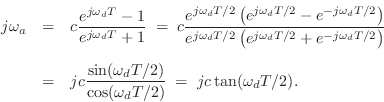
Thus, given a particular desired break-frequency
 , we can set
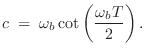
Recall from Eq.(8.19) that the transfer function of the
first-order analog allpass filter is given by
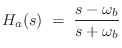 is the break frequency.
Applying the general bilinear transformation Eq.(8.20) gives
is the break frequency.
Applying the general bilinear transformation Eq.(8.20) gives


Figure 8.25 shows the digital phaser response curves corresponding
to the analog response curves in Fig.8.24. While the break
frequencies are preserved by construction, the notches have moved
slightly, although this is not visible from the plots. An overlay of
the total phase of the analog and digital allpass chains is shown in
Fig.8.26. We see that the phase responses of the analog and
digital alpass chains diverge visibly only above 9 kHz. The analog
phase response approaches zero in the limit as
 ,
while the digital phase response reaches zero at half the sampling
rate,
,
while the digital phase response reaches zero at half the sampling
rate,  kHz in this case. This is a good example of when the
bilinear transform performs very well.
kHz in this case. This is a good example of when the
bilinear transform performs very well.
![\includegraphics[width=\twidth]{eps/phaser1d}](http://www.dsprelated.com/josimages_new/pasp/img1925.png) |
![\includegraphics[width=\twidth]{eps/phaser1ad}](http://www.dsprelated.com/josimages_new/pasp/img1926.png) |
In general, the bilinear transform works well to digitize feedforward analog structures in which the high-frequency warping is acceptable. When frequency warping is excessive, it can be alleviated by the use of oversampling; for example, the slight visible deviation in Fig.8.26 below 10 kHz can be largely eliminated by increasing the sampling rate by 15% or so. See the case of digitizing the Moog VCF for an example in which the presence of feedback in the analog circuit leads to a delay-free loop in the digitized system [479,477].
Next Section:
Phasing with 2nd-Order Allpass Filters
Previous Section:
Body Factoring Example