







Single-Reed Theory
![\includegraphics[scale=0.9]{eps/fReedSchematic}](http://www.dsprelated.com/josimages_new/pasp/img2321.png)
A simplified diagram of the clarinet mouthpiece is shown in
Fig. 9.40. The pressure in the mouth is assumed
to be a constant value  , and the bore pressure
  is defined
located at the mouthpiece. Any pressure drop
is defined
located at the mouthpiece. Any pressure drop
 across
the mouthpiece causes a flow
across
the mouthpiece causes a flow  into the mouthpiece through the
reed-aperture impedance
into the mouthpiece through the
reed-aperture impedance
 which changes as a function of
 since the reed position is affected by
. To a first
approximation, the clarinet reed can be regarded as a spring flap
regulated Bernoulli flow (§B.7.5), [249]).
This model has been verified well experimentally until the reed is
about to close, at which point viscosity effects begin to appear
[102]. It has also been verified that the mass
of the reed can be neglected to first order,10.18 so that
is a
positive real number for all values of
. Possibly the most
important neglected phenomenon in this model is sound generation due
to turbulence of the flow, especially near reed closure. Practical
synthesis models have always included a noise component of some sort
which is modulated by the reed [431], despite a lack of firm
basis in acoustic measurements to date.
since the reed position is affected by
. To a first
approximation, the clarinet reed can be regarded as a spring flap
regulated Bernoulli flow (§B.7.5), [249]).
This model has been verified well experimentally until the reed is
about to close, at which point viscosity effects begin to appear
[102]. It has also been verified that the mass
of the reed can be neglected to first order,10.18 so that
is a
positive real number for all values of
. Possibly the most
important neglected phenomenon in this model is sound generation due
to turbulence of the flow, especially near reed closure. Practical
synthesis models have always included a noise component of some sort
which is modulated by the reed [431], despite a lack of firm
basis in acoustic measurements to date.
The fundamental equation governing the action of the reed is continuity of volume velocity, i.e.,

where
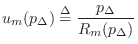
and
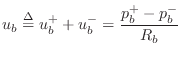
is the volume velocity corresponding to the incoming pressure wave
 and outgoing pressure wave
  . (The physical pressure in the bore at the
mouthpiece is of course
. (The physical pressure in the bore at the
mouthpiece is of course
 .) The wave impedance of the bore
air-column is denoted
.) The wave impedance of the bore
air-column is denoted  (computable as the air density times sound
speed
(computable as the air density times sound
speed  divided by cross-sectional area).
In operation, the mouth pressure and incoming traveling bore pressure
are given, and the reed computation must produce an outgoing bore
pressure which satisfies (9.35), i.e., such that

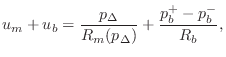



Solving for
is not immediate because of the dependence of  on
which, in turn, depends on . A graphical solution technique was
proposed [151,244,308] which, in effect, consists
of finding the intersection of the two terms of the equation as they are
plotted individually on the same graph, varying . This is analogous
to finding the operating point of a transistor by intersecting its
operating curve with the ``load line'' determined by the load resistance.
on
which, in turn, depends on . A graphical solution technique was
proposed [151,244,308] which, in effect, consists
of finding the intersection of the two terms of the equation as they are
plotted individually on the same graph, varying . This is analogous
to finding the operating point of a transistor by intersecting its
operating curve with the ``load line'' determined by the load resistance.
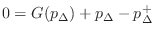
It is helpful to normalize (9.38) as follows: Define
 , and note that
 , where
 . Then (9.38) can be multiplied through by and
written as
. Then (9.38) can be multiplied through by and
written as
 , or
, or

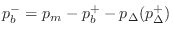
The solution is obtained by plotting
 and
and
 on the same graph,
finding the point of intersection at
on the same graph,
finding the point of intersection at  coordinates
 ,
and computing finally the outgoing pressure wave sample as
,
and computing finally the outgoing pressure wave sample as
 |
(10.40) |
An example of the qualitative appearance of overlaying
is shown in Fig. 9.41.
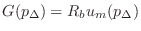 overlaid with the ``bore load line''
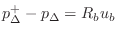 .
.![\includegraphics[width=\twidth]{eps/fReedRelations}](http://www.dsprelated.com/josimages_new/pasp/img2346.png)
Scattering-Theoretic Formulation
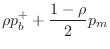
Equation (9.38) can be solved for to obtain

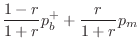

where
 |
(10.44) |
We interpret
 as a signal-dependent reflection
coefficient.
as a signal-dependent reflection
coefficient.
Since the mouthpiece of a clarinet is nearly closed,
 which
implies
which
implies
 and
and
 . In the limit as goes to
infinity relative to , (9.42) reduces to the simple form of a
rigidly capped acoustic tube, i.e.,
. In the limit as goes to
infinity relative to , (9.42) reduces to the simple form of a
rigidly capped acoustic tube, i.e.,
 .
If it were possible to open the reed wide enough to achieve
matched impedance,
.
If it were possible to open the reed wide enough to achieve
matched impedance,  , then we would have
  and
and  , in
which case
, in
which case
 , with no reflection of , as expected. If
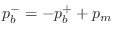
the mouthpiece is removed altogether to give
, with no reflection of , as expected. If
the mouthpiece is removed altogether to give  (regarding it now as a
tube section of infinite radius), then
(regarding it now as a
tube section of infinite radius), then  ,
,  , and
, and
 .
.
Computational Methods
Since finding the intersection of and
requires an expensive
iterative algorithm with variable convergence times, it is not well suited
for real-time operation. In this section, fast algorithms based on
precomputed nonlinearities are described.
Let  denote half-pressure
  , i.e.,
 and
and
 . Then (9.43) becomes
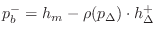
Subtracting this equation from
gives
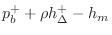
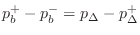

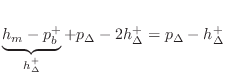


The last expression above can be used to precompute
 as a function of
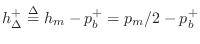 . Denoting this newly defined function as
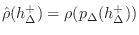 |
(10.47) |
(9.45) becomes
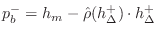
This is the form chosen for implementation in Fig. 9.39 [431]. The control variable is mouth half-pressure
 , and
, and
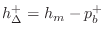 is computed from the
incoming bore pressure using only a single subtraction. The table is
indexed by
is computed from the
incoming bore pressure using only a single subtraction. The table is
indexed by
 , and the result of the lookup is then multiplied by
. Finally, the result of the multiplication is subtracted from
. The cost of the reed simulation is only two subtractions, one
multiplication, and one table lookup per sample.
, and the result of the lookup is then multiplied by
. Finally, the result of the multiplication is subtracted from
. The cost of the reed simulation is only two subtractions, one
multiplication, and one table lookup per sample.
Because the table contains a coefficient rather than a signal value, it
can be more heavily quantized both in address space and word length than
a direct lookup of a signal value such as
 or the like. A
direct signal lookup, though requiring much higher resolution, would
eliminate the multiplication associated with the scattering coefficient.
For example, if and are 16-bit signal samples,
the table would contain on the order of 64K 16-bit
or the like. A
direct signal lookup, though requiring much higher resolution, would
eliminate the multiplication associated with the scattering coefficient.
For example, if and are 16-bit signal samples,
the table would contain on the order of 64K 16-bit
 samples.
Clearly, some compression of this table would be desirable. Since
samples.
Clearly, some compression of this table would be desirable. Since
 is smoothly varying, significant compression is in fact
possible. However, because the table is directly in the signal path,
comparatively little compression can be done while maintaining full
audio quality (such as 16-bit accuracy).
is smoothly varying, significant compression is in fact
possible. However, because the table is directly in the signal path,
comparatively little compression can be done while maintaining full
audio quality (such as 16-bit accuracy).
![\includegraphics[width=4in]{eps/fReedTable}](http://www.dsprelated.com/josimages_new/pasp/img2382.png)
In the field of computer music, it is customary to use simple piecewise linear functions for functions other than signals at the audio sampling rate, e.g., for amplitude envelopes, FM-index functions, and so on [382,380]. Along these lines, good initial results were obtained [431] using the simplified qualitatively chosen reed table

depicted in Fig. 9.42 for
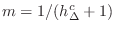 .
The corner point
.
The corner point
 is the smallest pressure difference giving reed
closure.10.19 Embouchure and reed stiffness correspond to the choice of offset
and slope
is the smallest pressure difference giving reed
closure.10.19 Embouchure and reed stiffness correspond to the choice of offset
and slope  . Brighter tones are obtained by increasing the
curvature of the function as the reed begins to open; for example, one can
use
. Brighter tones are obtained by increasing the
curvature of the function as the reed begins to open; for example, one can
use
 for increasing
  .
.
Another variation is to replace the table-lookup contents by a piecewise polynomial approximation. While less general, good results have been obtained in practice [89,91,92]. For example, one of the SynthBuilder [353] clarinet patches employs this technique using a cubic polynomial.
An intermediate approach between table lookups and polynomial approximations is to use interpolated table lookups. Typically, linear interpolation is used, but higher order polynomial interpolation can also be considered (see Chapter 4).
Clarinet Synthesis Implementation Details
To finish off the clarinet example, the remaining details of the SynthBuilder clarinet patch Clarinet2.sb are described.
The input mouth pressure is summed with a small amount of white noise,
corresponding to turbulence. For example, 0.1% is generally used as a
minimum, and larger amounts are appropriate during the attack of a note.
Ideally, the turbulence level should be computed automatically as a
function of pressure drop
and reed opening geometry
[141,530]. It should also be lowpass filtered
as predicted by theory.
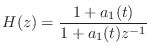
Referring to Fig. 9.39, the reflection filter is a simple one-pole with transfer function
 |
(10.50) |
where
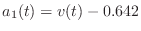 ,
,
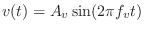 ,
,  is
vibrato amplitude (e.g.,
is
vibrato amplitude (e.g.,  ), and
  is vibrato frequency (e.g.,
  Hz). Further loop filtering occurs as a result of using simple linear
interpolation of the delay line. (There is only one delay line in the
actual implementation since the lower delay line of
Fig. 9.39 can be commuted with the reflection filter
and combined with the upper delay line, ignoring the path to the output
filter since a pure delay of less than a period in the final output sound
is inconsequential.) There is no transmission filter or tone-hole
modeling.
Hz). Further loop filtering occurs as a result of using simple linear
interpolation of the delay line. (There is only one delay line in the
actual implementation since the lower delay line of
Fig. 9.39 can be commuted with the reflection filter
and combined with the upper delay line, ignoring the path to the output
filter since a pure delay of less than a period in the final output sound
is inconsequential.) There is no transmission filter or tone-hole
modeling.
Legato note transitions are managed using two delay line taps and cross-fading from one to the other during a transition [208,441,405]. In general, legato problems arise when the bore length is changed suddenly while sounding, corresponding to a new fingering. The reason is that really the model itself should be changed during a fingering change from that of a statically terminated bore to that of a bore with a new scattering junction appearing where each ``finger'' is lifting, and with disappearing scattering junctions where tone holes are being covered. In addition, if a hole is covered abruptly (especially when there are large mechanical caps, as in the saxophone), there will also be new signal energy injected in both directions on the bore in superposition with the signal scattering. As a result of this ideal picture, is difficult to get high quality legato performance using only a single delay line.
A reduced-cost, approximate solution for obtaining good sounding note transitions in a single delay-line model was proposed in [208]. In this technique, the bore delay line is ``branched'' during the transition, i.e., a second feedback loop is formed at the new loop delay, thus forming two delay lines sharing the same memory, one corresponding to the old pitch and the other corresponding to the new pitch. A cross-fade from the old-pitch delay to the new-pitch delay sounds good if the cross-fade time and duration are carefully chosen. Another way to look at this algorithm is in terms of ``read pointers'' and ``write pointers.'' A normal delay line consists of a single write pointer followed by a single read pointer, delayed by one period. During a legato transition, we simply cross-fade from a read-pointer at the old-pitch delay to a read-pointer at the new-pitch delay. In this type of implementation, the write-pointer always traverses the full delay memory corresponding to the minimum supported pitch in order that read-pointers may be instantiated at any pitch-period delay at any time. Conceptually, this simplified model of note transitions can be derived from the more rigorous model by replacing the tone-hole scattering junction by a single reflection coefficient.
STK software implementing a model as in Fig.9.39 can be found in the file Clarinet.cpp.
Next Section:
Tonehole Modeling
Previous Section:
A View of Single-Reed Oscillation












