







``Traveling Waves'' in Lumped Systems
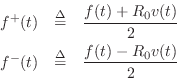
One of the topics in classical network theory is the reflection and transmission, or scattering formulation for lumped networks [35]. Lumped scattering theory also serves as the starting point for deriving wave digital filters (the subject of Appendix F). In this formulation, forces (voltages) and velocities (currents) are replaced by so-called wave variables
where  is an arbitrary reference impedance.
Since the above wave variables have dimensions of force, they
are specifically force waves. The corresponding velocity
waves are
is an arbitrary reference impedance.
Since the above wave variables have dimensions of force, they
are specifically force waves. The corresponding velocity
waves are
![\begin{eqnarray*}
v^{+}(t) &\isdef & \frac{1}{2}[v(t) + f(t)/R_0], \\
v^{-}(t) &\isdef & \frac{1}{2}[v(t) - f(t)/R_0].
\end{eqnarray*}](http://www.dsprelated.com/josimages_new/pasp/img3698.png)
Dropping the time argument, since it is always `(t)', we see that


and


These are the basic relations for traveling waves in an ideal medium such as an ideal vibrating string or acoustic tube. Using voltage and current gives elementary transmission line theory.
Reflectance of an Impedance
Let  denote the driving-point impedance of an arbitrary
continuous-time LTI system. Then, by definition,
denote the driving-point impedance of an arbitrary
continuous-time LTI system. Then, by definition,
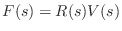 where
where  and
and  denote the Laplace transforms
of the applied force and resulting velocity, respectively.
The wave variable decomposition in Eq.
denote the Laplace transforms
of the applied force and resulting velocity, respectively.
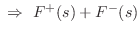
The wave variable decomposition in Eq. (C.74) gives


![$\displaystyle R(s) \left[V^{+}(s) + V^{-}(s)\right]$](http://www.dsprelated.com/josimages_new/pasp/img3711.png)
![$\displaystyle R(s) \left[\frac{F^{+}(s) - F^{-}(s)}{R_0}\right]$](http://www.dsprelated.com/josimages_new/pasp/img3712.png)
![$\displaystyle \,\,\Rightarrow\,\,F^{-}(s) \left[\frac{R(s)}{R_0}+1\right]$](http://www.dsprelated.com/josimages_new/pasp/img3713.png)
![$\displaystyle F^{+}(s) \left[\frac{R(s)}{R_0}-1\right]$](http://www.dsprelated.com/josimages_new/pasp/img3714.png)

![$\displaystyle F^{+}(s) \left[\frac{R(s)-R_0}{R(s)+R_0}\right]$](http://www.dsprelated.com/josimages_new/pasp/img3716.png)


We may call
 the reflectance of impedance relative
to . For example, if a transmission line with characteristic
impedance were terminated in a lumped impedance , the
reflection transfer function at the termination, as seen from the end
of the transmission line, would be
.
the reflectance of impedance relative
to . For example, if a transmission line with characteristic
impedance were terminated in a lumped impedance , the
reflection transfer function at the termination, as seen from the end
of the transmission line, would be
.
We are working with reflectance for force waves.
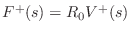
Using the elementary relations Eq.(C.73), i.e.,
 and
and
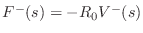 , we immediately obtain the corresponding
velocity-wave reflectance:
, we immediately obtain the corresponding
velocity-wave reflectance:

Next Section:
Properties of Passive Impedances
Previous Section:
Digital Waveguide Filters











