







Tonehole Modeling
Toneholes in woodwind instruments are essentially cylindrical holes in
the bore. One modeling approach would be to treat the tonehole as a
small waveguide which connects to the main bore via one port on a
three-port junction. However, since the tonehole length is small
compared with the distance sound travels in one sampling instant (
 in, e.g.), it is more straightforward to treat the
tonehole as a lumped load along the bore, and most modeling efforts
have taken this approach.
in, e.g.), it is more straightforward to treat the
tonehole as a lumped load along the bore, and most modeling efforts
have taken this approach.
The musical acoustics literature contains experimentally verified models of tone-hole acoustics, such as by Keefe [238]. Keefe's tonehole model is formulated as a ``transmission matrix'' description, which we may convert to a traveling-wave formulation by a simple linear transformation (described in §9.5.4 below) [465]. For typical fingerings, the first few open tone holes jointly provide a bore termination [38]. Either the individual tone holes can be modeled as (interpolated) scattering junctions, or the whole ensemble of terminating tone holes can be modeled in aggregate using a single reflection and transmission filter, like the bell model. Since the tone hole diameters are small compared with most audio frequency wavelengths, the reflection and transmission coefficients can be implemented to a reasonable approximation as constants, as opposed to cross-over filters as in the bell. Taking into account the inertance of the air mass in the tone hole, the tone hole can be modeled as a two-port loaded junction having load impedance equal to the air-mass inertance [143,509]. At a higher level of accuracy, adapting transmission-matrix parameters from the existing musical acoustics literature leads to first-order reflection and transmission filters [238,406,403,404,465]. The individual tone-hole models can be simple lossy two-port junctions, modeling only the internal bore loss characteristics, or three-port junctions, modeling also the transmission characteristics to the outside air. Another approach to modeling toneholes is the ``wave digital'' model [527] (see §F.1 for a tutorial introduction to this approach). The subject of tone-hole modeling is elaborated further in [406,502]. For simplest practical implementation, the bell model can be used unchanged for all tunings, as if the bore were being cut to a new length for each note and the same bell were attached. However, for best results in dynamic performance, the tonehole model should additionally include an explicit valve model for physically accurate behavior when slowly opening or closing the tonehole [405].
The Clarinet Tonehole as a Two-Port Junction
![\includegraphics[scale=0.9]{eps/fFingerHoleKeefe}](http://www.dsprelated.com/josimages_new/pasp/img2398.png)
The clarinet tonehole model developed by Keefe [240] is
parametrized in terms of series and shunt resistance and reactance, as
shown in Fig. 9.43. The transmission
matrix description of this two-port is given by the product of the
transmission matrices for the series impedance  , shunt
impedance
, shunt
impedance  , and series impedance , respectively:
![$\displaystyle \left[\begin{array}{c} P_1 \\ [2pt] U_1 \end{array}\right]$](http://www.dsprelated.com/josimages_new/pasp/img2401.png)
![$\displaystyle \left[\begin{array}{cc} 1 & R_a/2 \\ [2pt] 0 & 1 \end{array}\righ...
...1 \end{array}\right]
\left[\begin{array}{c} P_2 \\ [2pt] U_2 \end{array}\right]$](http://www.dsprelated.com/josimages_new/pasp/img2402.png)
![$\displaystyle \left[\begin{array}{cc} 1+\frac{R_a}{2R_s} & R_a[1+\frac{R_a}{4R_...
...} \end{array}\right]
\left[\begin{array}{c} P_2 \\ [2pt] U_2 \end{array}\right]$](http://www.dsprelated.com/josimages_new/pasp/img2403.png)
where all quantities are written in the frequency domain, and the impedance parameters are given by
(open-hole shunt impedance) |
 |
 |
|
(closed-hole shunt impedance) |
|
 |
(10.51) |
(open-hole series impedance) |
|
 |
|
(closed-hole series impedance) |
|
 |
where
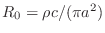
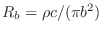 is the wave impedance of the tonehole
entrance, i.e., that of an acoustic tube of cross-sectional area
is the wave impedance of the tonehole
entrance, i.e., that of an acoustic tube of cross-sectional area  (
( is air density and
  is sound speed as usual),
  is the tonehole
radius,
is the tonehole
radius,
 is the wavenumber (radian spatial
frequency),
is the wavenumber (radian spatial
frequency),  is the open-tonehole effective length (which is slightly
greater than its physical length due to the formation of a small air-piston
inside the open tonehole),
is the open-tonehole effective length (which is slightly
greater than its physical length due to the formation of a small air-piston
inside the open tonehole),  is the ``specific resistance'' of the
open tonehole due to air viscosity in and radiation from the hole,
is the ``specific resistance'' of the
open tonehole due to air viscosity in and radiation from the hole,  is the
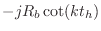
closed-tonehole height, defined such that its product times the
cross-sectional area of the tonehole exactly equals the geometric volume
is the
closed-tonehole height, defined such that its product times the
cross-sectional area of the tonehole exactly equals the geometric volume
 of the closed tonehole. Finally,
  and
and  are the
equivalent series lengths of the open and closed tonehole, respectively,
and are given by
are the
equivalent series lengths of the open and closed tonehole, respectively,
and are given by
 |
|
 |
|
 |
|
 |
where
 is the radius of the main bore. The closed-tonehole height
 can be estimated as [240]
![$\displaystyle t_h = t_w + \frac{1}{8}\frac{b^2}{a}\left[1+0.172\left(\frac{b}{a}\right)^2\right]
$](http://www.dsprelated.com/josimages_new/pasp/img2426.png)
 is the physical tonehole chimney height at its center.
Note that the specific resistance of the open tonehole, , is the
only real impedance and therefore the only source of wave energy loss at
the tonehole. It is given by [240]
 ln
ln
 is the radius of curvature of the tonehole,
  is the
viscous boundary layer thickness which expressible in terms of the shear
viscosity
is the
viscous boundary layer thickness which expressible in terms of the shear
viscosity  of air as

 is the real part of the propagation wavenumber (or minus the imaginary part
of complex spatial frequency
is the real part of the propagation wavenumber (or minus the imaginary part
of complex spatial frequency  ). In [239], for the large-tube limit (i.e.,
when the tube radius is large compared with the viscous boundary layer), is given
by
). In [239], for the large-tube limit (i.e.,
when the tube radius is large compared with the viscous boundary layer), is given
by
![$\displaystyle \alpha = \frac{1}{2bc}\left[\,\sqrt{\frac{2\eta\omega}{\rho}}
+ (\gamma-1)\sqrt{\frac{2\kappa\omega}{\rho C_p}}\,\right]
$](http://www.dsprelated.com/josimages_new/pasp/img2433.png)
 is the adiabatic gas constant for air
[318],
is the adiabatic gas constant for air
[318],  is the thermal conductivity of air, and
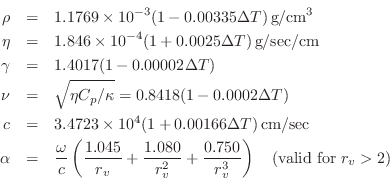
 is the specific heat of air at constant pressure. In [239], the
following values are given for air at
is the specific heat of air at constant pressure. In [239], the
following values are given for air at  Kelvin (
 C),
and valid within
C),
and valid within  degrees of that temperature:
where
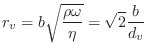
 times the ratio of the tonehole radius
to the viscous boundary layer thickness [239]. The constant
times the ratio of the tonehole radius
to the viscous boundary layer thickness [239]. The constant
 is referred to as the Prandtl number, and is the shear
viscosity coefficient [239]. In [71], it is noted that
is referred to as the Prandtl number, and is the shear
viscosity coefficient [239]. In [71], it is noted that  is greater than
  under practical conditions in musical acoustics, and so it
is therefore sufficient to keep only the first and second-order terms in the
expression above for .
under practical conditions in musical acoustics, and so it
is therefore sufficient to keep only the first and second-order terms in the
expression above for .
The open-hole effective length , assuming no pad above the hole,
is given in
[240] as
![$\displaystyle t_e = \frac{(1/k)\tan(kt) + b [1.40 - 0.58(b/a)^2]}{1 - 0.61 kb \tan(kt)}
$](http://www.dsprelated.com/josimages_new/pasp/img2445.png)
For implementation in a digital waveguide model, the lumped parameters above must be converted to scattering parameters. Such formulations of toneholes have appeared in the literature: Vesa Välimäki [509,502] developed tonehole models based on a ``three-port'' digital waveguide junction loaded by an inertance, as described in Fletcher and Rossing [143], and also extended his results to the case of interpolated digital waveguides. It should be noted in this context, however, that in the terminology of Appendix C, Välimäki's tonehole representation is a loaded 2-port junction rather than a three-port junction. (A load can be considered formally equivalent to a ``waveguide'' having wave impedance given by the load impedance.) Scavone and Smith [402] developed digital waveguide tonehole models based on the more rigorous ``symmetric T'' acoustic model of Keefe [240], using general purpose digital filter design techniques to obtain rational approximations to the ideal tonehole frequency response. A detailed treatment appears in Scavone's CCRMA Ph.D. thesis [406]. This section, adapted from [465], considers an exact translation of the Keefe tonehole model, obtaining two one-filter implementations: the ``shared reflectance'' and ``shared transmittance'' forms. These forms are shown to be stable without introducing an approximation which neglects the series inertance terms in the tonehole model.
By substituting
 in (9.53) to convert spatial
frequency to temporal frequency, and by substituting
in (9.53) to convert spatial
frequency to temporal frequency, and by substituting
 |
|
 |
(10.52) |
 |
|
 |
(10.53) |
for
 , into (9.51) to convert physical variables to wave
variables, (
, into (9.51) to convert physical variables to wave
variables, (
 is the bore wave impedance), we
may solve for the outgoing waves
is the bore wave impedance), we
may solve for the outgoing waves
 in terms
of the incoming waves
in terms
of the incoming waves
 . Mathematica code for
obtaining the general conversion formula from lumped parameters to
scattering parameters is as follows:
. Mathematica code for
obtaining the general conversion formula from lumped parameters to
scattering parameters is as follows:
        Clear["t*", "p*", "u*", "r*"]
        transmissionMatrix = {{t11, t12}, {t21, t22}};
        leftPort = {{p2p+p2m}, {(p2p-p2m)/r2}};
        rightPort = {{p1p+p1m}, {(p1p-p1m)/r1}};
        Format[t11, TeXForm] := "{T_{11}}"
        Format[p1p, TeXForm] := "{P_1^+}"
        ... (etc. for all variables) ...
        TeXForm[Simplify[Solve[leftPort ==
               transmissionMatrix . rightPort, {p1m, p2p}]]]
The above code produces the following formulas:



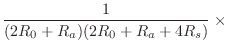
Substituting relevant values for Keefe's tonehole model, we obtain, in matrix notation,
![$\displaystyle \left[\begin{array}{c} P_1^{-} \\ [2pt] P_2^{+} \end{array}\right]$](http://www.dsprelated.com/josimages_new/pasp/img2459.png)
![$\displaystyle \left[\begin{array}{cc} S & T \\ [2pt] T & S \end{array}\right]
\left[\begin{array}{c} P_1^{+} \\ [2pt] P_2^{-} \end{array}\right]$](http://www.dsprelated.com/josimages_new/pasp/img2460.png)
![$\displaystyle \quad
\left[\begin{array}{cc} 4R_aR_s + R_a^2 - 4R_0^2 & 8R_0R_s ...
...rray}\right]
\left[\begin{array}{c} P_1^{+} \\ [2pt] P_2^{-} \end{array}\right]$](http://www.dsprelated.com/josimages_new/pasp/img2462.png)
We thus obtain the scattering formulation depicted in Fig. 9.44, where

is the reflectance of the tonehole (the same from either direction), and

is the transmittance of the tonehole (also the same from either direction). The notation ``
 '' for reflectance is chosen because every
reflectance is a Schur function (stable and not exceeding unit
magnitude on the unit circle in the
'' for reflectance is chosen because every
reflectance is a Schur function (stable and not exceeding unit
magnitude on the unit circle in the  plane) [428, p. 221].
![\includegraphics[scale=0.9]{eps/fFingerHoleScat}](http://www.dsprelated.com/josimages_new/pasp/img2465.png)
The approximate forms in (9.57) and (9.58) are obtained by neglecting
the negative series inertance  which serves to adjust the effective
length of the bore, and which therefore can be implemented elsewhere in the
interpolated delay-line calculation as discussed further below. The open
and closed tonehole cases are obtained by substituting
which serves to adjust the effective
length of the bore, and which therefore can be implemented elsewhere in the
interpolated delay-line calculation as discussed further below. The open
and closed tonehole cases are obtained by substituting
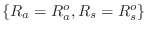 and
and
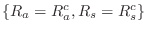 , respectively, from (9.53).
In a manner analogous to converting the four-multiply Kelly-Lochbaum (KL)
scattering junction
[245]
into a one-multiply form (cf. (C.60) and
(C.62) on page ![[*]](../icons/crossref.png) ), we may pursue a ``one-filter'' form of the waveguide
tonehole model. However, the series inertance gives some initial trouble,
since
), we may pursue a ``one-filter'' form of the waveguide
tonehole model. However, the series inertance gives some initial trouble,
since
![$\displaystyle [1+S(\omega)] - T(\omega) = \frac{2R_a}{2R_0+ R_a} \isdef L(\omega)
$](http://www.dsprelated.com/josimages_new/pasp/img2469.png) for the general loaded waveguide junction, the reflectance seen on any
branch is always the transmittance from that branch to any other
branch minus
for the general loaded waveguide junction, the reflectance seen on any
branch is always the transmittance from that branch to any other
branch minus  . I.e., if
  denotes the transmittance from
branch
denotes the transmittance from
branch  to all other branches meeting at the junction, then
 is the reflectance seen on branch . Substituting
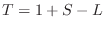 ,
we obtain, in the frequency domain,
,
we obtain, in the frequency domain,
 |
|
 |
|
|
![$\displaystyle SP_1^{+}+ [1 + S- L] P_2^{+}$](http://www.dsprelated.com/josimages_new/pasp/img2475.png) |
||
|
![$\displaystyle S[P_1^{+}+ P_2^{+}] + [1 - L] P_2^{+}$](http://www.dsprelated.com/josimages_new/pasp/img2476.png) |
||
 |
![$\displaystyle S[P_1^{+}+ P_2^{+}] + AP_2^{+}$](http://www.dsprelated.com/josimages_new/pasp/img2477.png) |
(10.58) |
and, similarly,
 |
|
![$\displaystyle S[P_1^{+}+ P_2^{+}] + AP_1^{+}$](http://www.dsprelated.com/josimages_new/pasp/img2479.png) |
(10.59) |
The resulting tonehole implementation is shown in Fig. 9.45. We call this the ``shared reflectance'' form of the tonehole junction.
In the same way, an alternate form is obtained from the substitution
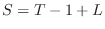
 |
|
![$\displaystyle T[P_1^{+}+ P_2^{+}] - AP_1^{+}$](http://www.dsprelated.com/josimages_new/pasp/img2482.png) |
(10.60) |
 |
|
![$\displaystyle T[P_1^{+}+ P_2^{+}] - AP_2^{+}$](http://www.dsprelated.com/josimages_new/pasp/img2484.png) |
(10.61) |
shown in Fig. 9.46.
![\includegraphics[scale=0.9]{eps/fFingerHoleOneMul}](http://www.dsprelated.com/josimages_new/pasp/img2485.png)
![\includegraphics[scale=0.9]{eps/fFingerHoleOneMulAlt}](http://www.dsprelated.com/josimages_new/pasp/img2486.png)
![\includegraphics[scale=0.9]{eps/fFingerHoleOneMulCommuted}](http://www.dsprelated.com/josimages_new/pasp/img2487.png) |
![\includegraphics[width=\twidth]{eps/fFingerHoleOneMulAltCommuted}](http://www.dsprelated.com/josimages_new/pasp/img2488.png)
Since
 , it can be neglected to first order, and
 , reducing both of the above forms to an approximate
``one-filter'' tonehole implementation.
, reducing both of the above forms to an approximate
``one-filter'' tonehole implementation.
Since
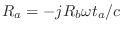 is a pure negative reactance, we have

In this form, it is clear that
 is a first-order allpass
filter with a single pole-zero pair near infinity. Unfortunately, the pole
is in the right-half-plane and hence unstable. We cannot therefore
implement it as shown in Fig. 9.45 or
Fig. 9.46. Using elementary manipulations, the
unstable allpasses in Figs. 9.45 and
Fig. 9.46 can be moved to the configuration shown
in Figs. 9.47 and
9.48, respectively. Note that
is a first-order allpass
filter with a single pole-zero pair near infinity. Unfortunately, the pole
is in the right-half-plane and hence unstable. We cannot therefore
implement it as shown in Fig. 9.45 or
Fig. 9.46. Using elementary manipulations, the
unstable allpasses in Figs. 9.45 and
Fig. 9.46 can be moved to the configuration shown
in Figs. 9.47 and
9.48, respectively. Note that
 is stable whenever
  is stable. The unstable
allpasses now operate only on the two incoming wave variables, and they can
be implemented implicitly by slightly reducing the (interpolated)
delay-lines leading to the junction from either side. The tonehole then
requires only one filter
is stable. The unstable
allpasses now operate only on the two incoming wave variables, and they can
be implemented implicitly by slightly reducing the (interpolated)
delay-lines leading to the junction from either side. The tonehole then
requires only one filter  or
or  .
.
We now see precisely how the negative series inertance provides a
negative, frequency-dependent, length correction for the bore. From
(9.63),
the phase delay of can be computed as
 , series tonehole length
  , tonehole impedance
  , or
main bore admittance
, or
main bore admittance
 .
.
In practice, it is common to combine all delay corrections into a single ``tuning allpass filter'' for the whole bore [428,207]. Whenever the desired allpass delay goes negative, we simply add a sample of delay to the desired allpass phase-delay and subtract it from the nearest delay. In other words, negative delays have to be ``pulled out'' of the allpass and used to shorten an adjacent interpolated delay line. Such delay lines are normally available in practical modeling situations.
Tonehole Filter Design
The tone-hole reflectance and transmittance must be converted to
discrete-time form for implementation in a digital waveguide model.
Figure 9.49 plots the responses of second-order discrete-time
filters designed to approximate the continuous-time magnitude and phase
characteristics of the reflectances for closed and open toneholes, as
carried out in [403,406]. These filter designs
assumed a tonehole of radius  mm, minimum tonehole height
 mm, tonehole radius of curvature
 mm, and air column
radius
mm, and air column
radius  mm. Since the measurements of Keefe do not extend to 5
kHz, the continuous-time responses in the figures are extrapolated above
this limit. Correspondingly, the filter designs were weighted to produce
best results below 5 kHz.
mm. Since the measurements of Keefe do not extend to 5
kHz, the continuous-time responses in the figures are extrapolated above
this limit. Correspondingly, the filter designs were weighted to produce
best results below 5 kHz.
The closed-hole filter design was carried out using weighted  equation-error minimization [428, p. 47], i.e., by minimizing
![$ \vert\vert\,W(e^{j\omega})[{\hat A}(e^{j\omega})H(e^{j\omega}) - {\hat B}(e^{j\omega})]\,\vert\vert _2$](http://www.dsprelated.com/josimages_new/pasp/img2504.png) , where
, where  is the weighting
function,
is the weighting
function,
 is the desired frequency response,
  denotes
discrete-time radian frequency, and the designed filter response is
denotes
discrete-time radian frequency, and the designed filter response is
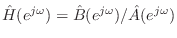 . Note that both phase and magnitude are
matched by equation-error minimization, and this error criterion is used
extensively in the field of system identification [288]
due to its ability to design optimal IIR filters via quadratic
minimization. In the spirit of the well-known Steiglitz-McBride algorithm
[287], equation-error minimization can be iterated,
setting the weighting function at iteration
. Note that both phase and magnitude are
matched by equation-error minimization, and this error criterion is used
extensively in the field of system identification [288]
due to its ability to design optimal IIR filters via quadratic
minimization. In the spirit of the well-known Steiglitz-McBride algorithm
[287], equation-error minimization can be iterated,
setting the weighting function at iteration  to the inverse of the
inherent weighting
to the inverse of the
inherent weighting
 of the previous iteration, i.e.,
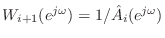 . However, for this study, the weighting was used only to
increase accuracy at low frequencies relative to high frequencies.
Weighted equation-error minimization is implemented in the matlab function
invfreqz() (§8.6.4).
. However, for this study, the weighting was used only to
increase accuracy at low frequencies relative to high frequencies.
Weighted equation-error minimization is implemented in the matlab function
invfreqz() (§8.6.4).
The open-hole discrete-time filter was designed using Kopec's method [297], [428, p. 46] in conjunction with weighted equation-error minimization. Kopec's method is based on linear prediction:
- Given a desired complex frequency response
, compute an
allpole model
 using linear prediction
- Compute the error spectrum
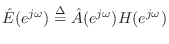 .
.
- Compute an allpole model
 for
for
 by
minimizing
by
minimizing

ratio error
 ratio-error norm. Thus, in Kopec's method, the poles model the upper
spectral envelope, while the zeros model the lower spectral envelope.
To apply Kopec's method to the design of an open-tonehole filter, a
one-pole model
ratio-error norm. Thus, in Kopec's method, the poles model the upper
spectral envelope, while the zeros model the lower spectral envelope.
To apply Kopec's method to the design of an open-tonehole filter, a
one-pole model
 was first fit to the continuous-time
response,
was first fit to the continuous-time
response,
 Subsequently, the inverse error spectrum,
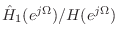 was modeled with a two-pole
digital filter,
was modeled with a two-pole
digital filter,
 The discrete-time approximation to
 was then given by

![\includegraphics[width=\twidth]{eps/twoptfilts}](http://www.dsprelated.com/josimages_new/pasp/img2522.png) |
 kHz.
The open tonehole has one anti-resonance in the audio band near
kHz.
The open tonehole has one anti-resonance in the audio band near  kHz.
At
kHz.
At The reasonably close match in both phase and magnitude by second-order filters indicates that there is in fact only one important tonehole resonance and/or anti-resonance within the audio band, and that the measured frequency responses can be modeled with very high audio accuracy using only second-order filters.
Figure 9.50 plots the reflection function calculated for a six-hole flute bore, as described in [240].
![\includegraphics[width=\twidth]{eps/gtwoport}](http://www.dsprelated.com/josimages_new/pasp/img2523.png) |
 (three finger holes closed, three finger holes open) on a simple flute (from [
The Tonehole as a Two-Port Loaded Junction
It seems reasonable to expect that the tonehole should be
representable as a load along a waveguide bore model, thus
creating a loaded two-port junction with two identical bore ports on
either side of the tonehole. From the relations for the loaded
parallel junction (C.101), in the two-port case
with
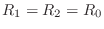 , and considering pressure waves rather than force
waves, we have
, and considering pressure waves rather than force
waves, we have
 |
|
![$\displaystyle \alpha P_1^{+}+ \alpha P_2^{+}, \quad \alpha = 2\Gamma _0/[G_J(s)+2\Gamma _0]$](http://www.dsprelated.com/josimages_new/pasp/img2526.png) |
(10.63) |
 |
|
 |
(10.64) |
 |
|
 |
(10.65) |
Thus, the loaded two-port junction can be implemented in ``one-filter form'' as shown in Fig. 9.48 with
 (
(
 ) and
) and

 ), is
equivalent to a loaded two-port waveguide junction with
), is
equivalent to a loaded two-port waveguide junction with  ,
i.e., the parallel load impedance is simply the shunt impedance in the
tonehole model.
,
i.e., the parallel load impedance is simply the shunt impedance in the
tonehole model.
Each series impedance in the split-T model of
Fig. 9.43 can be modeled as a series waveguide
junction with a load of . To see this, set the transmission
matrix parameters in (9.55) to the values
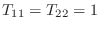 ,
,
 , and
, and  from (9.51) to get
 |
|
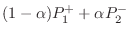 |
|
 |
|
 |
(10.66) |
where
 is the alpha parameter for a series
loaded waveguide junction involving two impedance
is the alpha parameter for a series
loaded waveguide junction involving two impedance  waveguides joined
in series with each other and with a load impedance of , as
can be seen from (C.99). To obtain exactly the loaded series
scattering relations (C.100), we first switch to the more general
convention in which the ``
waveguides joined
in series with each other and with a load impedance of , as
can be seen from (C.99). To obtain exactly the loaded series
scattering relations (C.100), we first switch to the more general
convention in which the `` '' superscript denotes waves traveling into a junction of any number of waveguides. This exchanges ``'' with ``
 ''
at port 2 to yield
''
at port 2 to yield
|
|
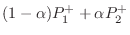 |
|
 |
|
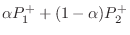 |
(10.67) |
Next we convert pressure to velocity using
 and
and
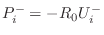 to obtain
 |
|
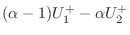 |
|
 |
|
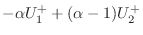 |
(10.68) |
Finally, we toggle the reference direction of port 2 (the ``current'' arrow for
 on port 2 in Fig. 9.43) so that velocity is
positive flowing into the junction on both ports (which is the
convention used to derive (C.100) and which is typically followed
in circuit theory). This amounts to negating
on port 2 in Fig. 9.43) so that velocity is
positive flowing into the junction on both ports (which is the
convention used to derive (C.100) and which is typically followed
in circuit theory). This amounts to negating  , giving
|
|
 |
|
|
|
 |
(10.69) |
where
 .
This is then the canonical form (C.100).
.
This is then the canonical form (C.100).
Next Section:
Digital Waveguide Bowed-String
Previous Section:
Single-Reed Theory












