Hilbert Transform Design Example
We will now use the window method to design a complex bandpass filter which passes positive frequencies and rejects negative frequencies.
Since every real signal  possesses a Hermitian spectrum
 , i.e.,
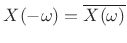 , it follows that, if
we filter out the negative frequencies, we will destroy this spectral
symmetry, and the output signal will be complex for every nonzero real
input signal (excluding dc and half the sampling rate). In other
terms, we want a filter which produces a ``single sideband'' (SSB)
output signal in response to any real input signal. The Hermitian
spectrum of a real signal can be viewed as two sidebands about
dc (with one sideband being the ``conjugate flip'' of the other). See
§2.3.3 for a review of Fourier symmetry-properties for
real signals.
, it follows that, if
we filter out the negative frequencies, we will destroy this spectral
symmetry, and the output signal will be complex for every nonzero real
input signal (excluding dc and half the sampling rate). In other
terms, we want a filter which produces a ``single sideband'' (SSB)
output signal in response to any real input signal. The Hermitian
spectrum of a real signal can be viewed as two sidebands about
dc (with one sideband being the ``conjugate flip'' of the other). See
§2.3.3 for a review of Fourier symmetry-properties for
real signals.
An ``analytic signal'' in signal processing is defined as any
signal
having only positive or only negative frequencies, but
not both (typically only positive frequencies). In principle, the
imaginary part of an analytic signal is computed from its real part by
the Hilbert transform (defined and discussed below). In other
words, one can ``filter out'' the negative-frequency components of a
signal
by taking its Hilbert transform
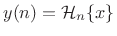 and forming the analytic signal
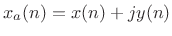 . Thus, an
alternative problem specification is to ask for a (real) filter which
approximates the Hilbert transform as closely as possible for a given
filter order.
. Thus, an
alternative problem specification is to ask for a (real) filter which
approximates the Hilbert transform as closely as possible for a given
filter order.
Primer on Hilbert Transform Theory
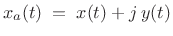
We need a Hilbert-transform filter  to compute the imaginary
part
to compute the imaginary
part  of the analytic signal
  given its real part
 . That is,
 |
(5.14) |
where
 . In the frequency domain, we have
![$\displaystyle X_a(\omega) \eqsp X(\omega) + j\,Y(\omega) \eqsp \left[1+j\,H(\omega)\right]\,X(\omega)$](http://www.dsprelated.com/josimages_new/sasp2/img748.png) |
(5.15) |
where
 denotes the frequency response of the Hilbert
transform
. Since by definition we have
denotes the frequency response of the Hilbert
transform
. Since by definition we have
 for
for
 , we must have
 for
, so that
for
, so that
 for negative frequencies (an allpass response with
phase-shift
for negative frequencies (an allpass response with
phase-shift  degrees). To pass the positive-frequency components
unchanged, we would most naturally define
degrees). To pass the positive-frequency components
unchanged, we would most naturally define
 for
for
 . However, conventionally, the positive-frequency
Hilbert-transform frequency response is defined more symmetrically as
. However, conventionally, the positive-frequency
Hilbert-transform frequency response is defined more symmetrically as
 for
, which gives
for
, which gives
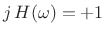 and
and
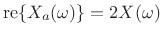 , i.e., the positive-frequency
components of
, i.e., the positive-frequency
components of  are multiplied by
  .
.
In view of the foregoing, the frequency response of the ideal Hilbert-transform filter may be defined as follows:
![$\displaystyle H(\omega) \isdefs \left\{\begin{array}{ll} \quad\! j, & \omega<0 \\ [5pt] \quad\!0, & \omega=0 \\ [5pt] -j, & \omega>0 \\ \end{array} \right. \protect$](http://www.dsprelated.com/josimages_new/sasp2/img760.png)
Note that the point at
 can be defined arbitrarily since the
inverse-Fourier transform integral is not affected by a single finite
point (being a ``set of measure zero'').
can be defined arbitrarily since the
inverse-Fourier transform integral is not affected by a single finite
point (being a ``set of measure zero'').
The ideal filter impulse response  is obtained by finding the
inverse Fourier transform of (4.16). For discrete time, we may
take the inverse DTFT of (4.16) to obtain the ideal discrete-time
Hilbert-transform impulse response, as pursued in Problem 10.
We will work with the usual continuous-time limit
is obtained by finding the
inverse Fourier transform of (4.16). For discrete time, we may
take the inverse DTFT of (4.16) to obtain the ideal discrete-time
Hilbert-transform impulse response, as pursued in Problem 10.
We will work with the usual continuous-time limit
 in
the next section.
in
the next section.
Hilbert Transform
The Hilbert transform
of a real, continuous-time signal
may be expressed as the convolution of  with the
Hilbert transform kernel:
with the
Hilbert transform kernel:
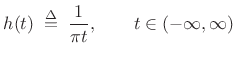
That is, the Hilbert transform of
is given by
 |
(5.18) |
Thus, the Hilbert transform is a non-causal linear time-invariant filter.
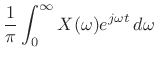
The complex analytic signal
corresponding to the real signal
is
then given by
 |
 |
 |
|
![$\displaystyle %\qquad \hbox{(Analytic signal corresponding to $x$)}\\ [10pt]
$](http://www.dsprelated.com/josimages_new/sasp2/img766.png) |
 |
 |
(5.19) |
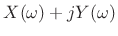
To show this last equality (note the lower limit of 0
instead of the
usual  ), it is easiest to apply (4.16) in the frequency
domain:
), it is easiest to apply (4.16) in the frequency
domain:
 |
|
 |
|
|
 |
(5.20) | |
|
 |
(5.21) |
Thus, the negative-frequency components of
are canceled, while the
positive-frequency components are doubled. This occurs because, as
discussed above, the Hilbert transform is an allpass filter that
provides a  degree phase shift at all negative frequencies, and a
 degree phase shift at all positive frequencies, as indicated in
(4.16). The use of the Hilbert transform to create an analytic
signal from a real signal is one of its main applications. However,
as the preceding sections make clear, a Hilbert transform in practice
is far from ideal because it must be made finite-duration in some way.
degree phase shift at all positive frequencies, as indicated in
(4.16). The use of the Hilbert transform to create an analytic
signal from a real signal is one of its main applications. However,
as the preceding sections make clear, a Hilbert transform in practice
is far from ideal because it must be made finite-duration in some way.
Filtering and Windowing the Ideal
Hilbert-Transform Impulse Response
Let  denote the convolution kernel of the continuous-time
Hilbert transform from (4.17) above:
denote the convolution kernel of the continuous-time
Hilbert transform from (4.17) above:

Convolving a real signal
with this kernel produces the
imaginary part of the corresponding analytic signal. The way the
``window method'' for digital filter design is classically done is to
simply sample the ideal impulse response to obtain  and then window it to give
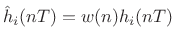 . However, we
know from above (e.g., §4.5.2) that we need to provide
transition bands in order to obtain a reasonable design. A
single-sideband filter needs a transition band between dc and
. However, we
know from above (e.g., §4.5.2) that we need to provide
transition bands in order to obtain a reasonable design. A
single-sideband filter needs a transition band between dc and
 , or higher, where
denotes the main-lobe width
(in rad/sample) of the window
, or higher, where
denotes the main-lobe width
(in rad/sample) of the window  we choose, and a second transition
band is needed between
we choose, and a second transition
band is needed between
 and
and  .
.
Note that we cannot allow a time-domain sample at time 0 in (4.22) because it would be infinity. Instead, time 0 should be taken to lie between two samples, thereby introducing a small non-integer advance or delay. We'll choose a half-sample delay. As a result, we'll need to delay the real-part filter by half a sample as well when we make a complete single-sideband filter.
The matlab below illustrates the design of an FIR Hilbert-transform
filter by the window method using a Kaiser window. For a more
practical illustration, the sampling-rate assumed is set to
 Hz instead of being normalized to 1 as usual. The
Kaiser-window
Hz instead of being normalized to 1 as usual. The
Kaiser-window  parameter is set to
  , which normally gives
``pretty good'' audio performance (cf. Fig.3.28). From
Fig.3.28, we see that we can expect a stop-band attenuation
better than
, which normally gives
``pretty good'' audio performance (cf. Fig.3.28). From
Fig.3.28, we see that we can expect a stop-band attenuation
better than  dB. The choice of
, in setting the
time-bandwidth product of the Kaiser window, determines both the
stop-band rejection and the transition bandwidths required by our FIR
frequency response.
dB. The choice of
, in setting the
time-bandwidth product of the Kaiser window, determines both the
stop-band rejection and the transition bandwidths required by our FIR
frequency response.
  M = 257;    % window length = FIR filter length (Window Method)
  fs = 22050; % sampling rate assumed (Hz)
  f1 = 530;   % lower pass-band limit = transition bandwidth (Hz)
  beta = 8;   % beta for Kaiser window for decent side-lobe rejection
Recall that, for a rectangular window, our minimum transition bandwidth would be
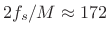 Hz, and for a Hamming window,
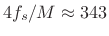 Hz. In this example, using a Kaiser window with
 (
(
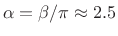 ), the main-lobe width is on
the order of
), the main-lobe width is on
the order of
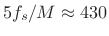 Hz, so we expect transition
bandwidths of this width. The choice
Hz, so we expect transition
bandwidths of this width. The choice  above should therefore
be sufficient, but not ``tight''.5.8 For
each doubling of the filter length (or each halving of the sampling
rate), we may cut
above should therefore
be sufficient, but not ``tight''.5.8 For
each doubling of the filter length (or each halving of the sampling
rate), we may cut  in half.
Matlab, Continued
Given the above design parameters, we compute some derived parameters as follows:
  fn = fs/2;             % Nyquist limit (Hz)
  f2 = fn - f1;          % upper pass-band limit
  N = 2^(nextpow2(8*M)); % large FFT for interpolated display
  k1 = round(N*f1/fs);   % lower band edge in bins
  if k1<2, k1=2; end;    % cannot have dc or fn response
  kn = N/2 + 1;          % bin index at Nyquist limit (1-based)
  k2 = kn-k1+1;          % high-frequency band edge
  f1 = k1*fs/N           % quantized band-edge frequencies
  f2 = k2*fs/N
Setting the upper transition band the same as the low-frequency band (
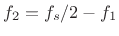 ) provides an additional benefit: the symmetry of
the desired response about
) provides an additional benefit: the symmetry of
the desired response about  cuts the computational expense of
the filter in half, because it forces every other sample in the
impulse response to be zero [224, p.
172].5.9
cuts the computational expense of
the filter in half, because it forces every other sample in the
impulse response to be zero [224, p.
172].5.9
Kaiser Window
With the filter length  and Kaiser window
as given
above, we may compute the Kaiser window itself in matlab via
and Kaiser window
as given
above, we may compute the Kaiser window itself in matlab via
w = kaiser(M,beta)'; % Kaiser window in "linear phase form"The spectrum of this window (zero-padded by more than a factor of 8) is shown in Fig.4.9 (full magnitude spectrum) and Fig.4.10 (zoom-in on the main lobe).
![\includegraphics[width=0.8\twidth]{eps/KaiserFR}](http://www.dsprelated.com/josimages_new/sasp2/img792.png)
![\includegraphics[width=0.8\twidth]{eps/KaiserZoomFR}](http://www.dsprelated.com/josimages_new/sasp2/img793.png)
Windowing a Desired Impulse Response Computed by the
Frequency Sampling Method
The next step is to apply our Kaiser window to the ``desired'' impulse
response, where ``desired'' means a time-shifted (by 1/2 sample) and
bandlimited (to introduce transition bands) version of the ``ideal''
impulse response in (4.22). In principle, we are using the
frequency-sampling method (§4.4) to prepare a
desired FIR filter of length  as the inverse FFT of a desired
frequency response prepared by direct Fourier intuition. This long
FIR filter is then ``windowed'' down to length
to give us our
final FIR filter designed by the window method.
as the inverse FFT of a desired
frequency response prepared by direct Fourier intuition. This long
FIR filter is then ``windowed'' down to length
to give us our
final FIR filter designed by the window method.
If the smallest transition bandwidth is
Hz, then the FFT size  should satisfy
 . Otherwise, there may be too much time
aliasing in the desired impulse response.5.10 The only non-obvious
part in the matlab below is ``
. Otherwise, there may be too much time
aliasing in the desired impulse response.5.10 The only non-obvious
part in the matlab below is ``.^8'' which smooths the taper to
zero and looks better on a log magnitude scale. It would also make
sense to do a linear taper on a dB scale which corresponds to
an exponential taper to zero.
H = [ ([0:k1-2]/(k1-1)).^8,ones(1,k2-k1+1),...
      ([k1-2:-1:0]/(k1-1)).^8, zeros(1,N/2-1)];
Figure 4.11 shows our desired amplitude response so constructed.
![\includegraphics[width=0.8\twidth]{eps/hilbertFRIdeal}](http://www.dsprelated.com/josimages_new/sasp2/img796.png)
Now we inverse-FFT the desired frequency response to obtain the desired impulse response:
h = ifft(H); % desired impulse response
hodd = imag(h(1:2:N));     % This should be zero
ierr = norm(hodd)/norm(h); % Look at numerical round-off error
% Typical value: ierr = 4.1958e-15
% Also look at time aliasing:
aerr = norm(h(N/2-N/32:N/2+N/32))/norm(h);
% Typical value: 4.8300e-04
The real part of the desired impulse response is shown in Fig.4.12, and the imaginary part in Fig.4.13.
![\includegraphics[width=0.8\twidth]{eps/hilbertIRRealIdeal}](http://www.dsprelated.com/josimages_new/sasp2/img797.png)
![\includegraphics[width=0.8\twidth]{eps/hilbertIRImagIdeal}](http://www.dsprelated.com/josimages_new/sasp2/img798.png)
Now use the Kaiser window to time-limit the desired impulse response:
% put window in zero-phase form:
wzp = [w((M+1)/2:M), zeros(1,N-M), w(1:(M-1)/2)];
hw = wzp .* h; % single-sideband FIR filter, zero-centered
Hw = fft(hw);  % for results display: plot(db(Hw));
hh = [hw(N-(M-1)/2+1:N),hw(1:(M+1)/2)]; % caual FIR
% plot(db(fft([hh,zeros(1,N-M)]))); % freq resp plot
Figure 4.14 and Fig.4.15
show the normalized dB magnitude frequency response of our
final FIR filter consisting of the  nonzero samples of
hw.
nonzero samples of
hw.
![\includegraphics[width=0.8\twidth]{eps/KaiserHilbertFR}](http://www.dsprelated.com/josimages_new/sasp2/img799.png)
![\includegraphics[width=0.8\twidth]{eps/KaiserHilbertZoomedFR}](http://www.dsprelated.com/josimages_new/sasp2/img800.png)
More General FIR Filter Design
We have looked at more than just FIR filter design by the window method and frequency-sampling technique. The general steps were
- Prepare a desired frequency-response that ``seems achievable''
- Inverse FFT
- Window the result (time-limit it)
- FFT that to see how it looks
Comparison to Optimal Chebyshev FIR Filter
Let's now compare the window-method design using the Kaiser window to the optimal equiripple FIR filter design given by the Remez multiple exchange algorithm.
Note, by the way, that many filter-design software functions, such as firpm have special modes for designing Hilbert-transform filters [224].
It turns out that the Remez exchange algorithm has convergence
problems for filters larger than a few hundred taps. Therefore, the
FIR filter length
was chosen above to be small enough to work
out in this comparison. However, keep in mind that for very large
filter orders, the Remez exchange method may not be an option. There
are more recently developed methods for optimal Chebyshev FIR filter
design, using ``convex optimization'' techniques, that may continue to
work at very high orders
[218,22,153]. The fast nonparametric
methods discussed above (frequency sampling, window method) will work
fine at extremely high orders.
The following Matlab command will try to design the FIR Hilbert-transform filter of the desired length with the desired transition bands:
hri = firpm(M-1, [f1,f2]/fn, [1,1], [1], 'Hilbert');Instead, however, we will use a more robust method [228] which uses the Remez exchange algorithm to design a lowpass filter, followed by modulation of the lowpass impulse-response by a complex sinusoid at frequency
in order to frequency-shift the lowpass to the single-sideband
filter we seek:
tic; % remember the current time
hrm = firpm(M-1, [0,(f2-fs/4)/fn,0.5,1], [1,1,0,0], [1,10]);
dt = toc; % design time dt can be minutes
hr = hrm .* j .^ [0:M-1]; % modulate lowpass to single-sideband
The weighting [1,10] in the call to firpm above says ``make the pass-band ripple
 times that of the stop-band.'' For
steady-state audio spectra, pass-band ripple can be as high as
times that of the stop-band.'' For
steady-state audio spectra, pass-band ripple can be as high as  dB or more without audible consequences.5.11 The result is
shown in Fig.4.16 (full amplitude response) and
Fig.4.17 (zoom-in on the dc transition band). By
symmetry the high-frequency transition region is identical (but
flipped):
dB or more without audible consequences.5.11 The result is
shown in Fig.4.16 (full amplitude response) and
Fig.4.17 (zoom-in on the dc transition band). By
symmetry the high-frequency transition region is identical (but
flipped):
![\includegraphics[width=0.8\twidth]{eps/OptimalHilbertFR}](http://www.dsprelated.com/josimages_new/sasp2/img802.png) |
![\includegraphics[width=0.8\twidth]{eps/OptimalHilbertZoomedFR}](http://www.dsprelated.com/josimages_new/sasp2/img803.png)
In this case we did not normalize the peak amplitude response to 0 dB because it has a ripple peak of about 1 dB in the pass-band. Figure 4.18 shows a zoom-in on the pass-band ripple.
![\includegraphics[width=0.8\twidth]{eps/OptimalHilbertZoomedPB}](http://www.dsprelated.com/josimages_new/sasp2/img804.png)
Conclusions
We can note the following points regarding our single-sideband FIR filter design by means of direct Fourier intuition, frequency-sampling, and the window-method:
- The pass-band ripple is much smaller than 0.1 dB, which is
``over designed'' and therefore wasting of taps.
- The stop-band response ``droops'' which ``wastes'' filter taps
when stop-band attenuation is the only stop-band specification. In
other words, the first stop-band ripple drives the spec (
 dB),
while all higher-frequency ripples are over-designed. On the other
hand, a high-frequency ``roll-off'' of this nature is quite natural
in the frequency domain, and it corresponds to a ``smoother pulse''
in the time domain. Sometimes making the stop-band attenuation
uniform will cause small impulses at the beginning and end of
the impulse response in the time domain. (The pass-band and
stop-band ripple can ``add up'' under the inverse Fourier transform
integral.) Recall this impulsive endpoint phenomenon for the
Chebyshev window shown in Fig.3.33.
dB),
while all higher-frequency ripples are over-designed. On the other
hand, a high-frequency ``roll-off'' of this nature is quite natural
in the frequency domain, and it corresponds to a ``smoother pulse''
in the time domain. Sometimes making the stop-band attenuation
uniform will cause small impulses at the beginning and end of
the impulse response in the time domain. (The pass-band and
stop-band ripple can ``add up'' under the inverse Fourier transform
integral.) Recall this impulsive endpoint phenomenon for the
Chebyshev window shown in Fig.3.33.
- The pass-band is degraded by early roll-off. The pass-band edge
is not exactly in the desired place.
- The filter length can be thousands of taps long without running
into numerical failure. Filters this long are actually needed for
sampling rate conversion
[270,218].
We can also note some observations regarding the optimal Chebyshev version designed by the Remez multiple exchange algorithm:
- The stop-band is ideal, equiripple.
- The transition bandwidth is close to half that of the
window method. (We already knew our chosen transition bandwidth was
not ``tight'', but our rule-of-thumb based on the Kaiser-window
main-lobe width predicted only about
 % excess width.)
- The pass-band is ideal, though over-designed for static audio spectra.
- The computational design time is orders of magnitude larger
than that for window method.
- The design fails to converge for filters much longer than 256
taps. (Need to increase working precision or use a different
method to get longer optimal Chebyshev FIR filters.)
Next Section:
Generalized Window Method
Previous Section:
Window Method for FIR Filter Design