








The Real Star of Star Trek
Unless you've been living under a rock recently, you're probably aware that this month is the 50-year anniversary of the original Star Trek show on American television. It's an anniversary worth noting, as did Time Magazine with their special...
An s-Plane to z-Plane Mapping Example
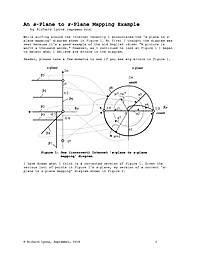
While surfing around the Internet recently I encountered the 's-plane to z-plane mapping' diagram shown in Figure 1. At first I thought the diagram was neat because it's a good example of the old English idiom: "A picture is worth a thousand...
Should DSP Undergraduate Students Study Z-transform Regions of Convergence?
Not long ago I presented my 3-day DSP class to a group of engineers at Tektronix Inc. in Beaverton Oregon [1]. After I finished covering my material on IIR filters' z-plane pole locations and filter stability, one of the Tektronix engineers asked...
Use DPLL to Lock Digital Oscillator to 1PPS Signal
Introduction There are occasions where it is desirable to lock a digital oscillator to an external time reference such as the 1PPS (One Pulse Per Second) signal output from a GPS receiver. One approach would be to synchronize a fixed frequency...
Implementing Impractical Digital Filters
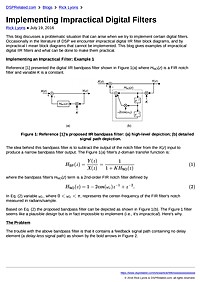
This blog discusses a problematic situation that can arise when we try to implement certain digital filters. Occasionally in the literature of DSP we encounter impractical digital IIR filter block diagrams, and by impractical I mean block...
An Astounding Digital Filter Design Application
I've recently encountered a digital filter design application that astonished me with its design flexibility, capability, and ease of use. The software is called the " ASN Filter Designer." After experimenting with a demo version of...
PID Without a PhD
I both consult and teach in the area of digital control. Through both of these efforts, I have found that while there certainly are control problems that require all the expertise I can bring to bear, there are a great number of control problems...
Harmonic Notch Filter
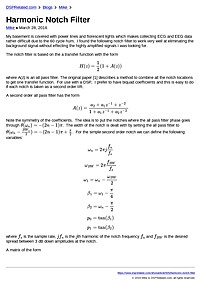
My basement is covered with power lines and florescent lights which makes collecting ECG and EEG data rather difficult due to the 60 cycle hum. I found the following notch filter to work very well at eliminating the background signal...
A Useful Source of Signal Processing Information
I just discovered a useful web-based source of signal processing information that was new to me. I thought I'd share what I learned with the subscribers here on DSPRelated.com. The Home page of the web site that I found doesn't look at...
3 Good News
Good News #1 Last week, I announced a new and ambitious reward program that will be funded by the new Vendors Directory. This week, I am happy to announce that we have our firsts two sponsors! Quantum Leaps & Abelon Systems have...
Filtering Noise: The Basics (Part 1)
IntroductionFinding signals in the presence of noise is one of the fundamental quests of the discipline of signal processing. Noise is inherently random by nature, so a probability oriented approach is needed to develop a mathematical framework...
Off-Topic: A Fluidic Model of the Universe
Introduction This article is a followup to my previous article "Off Topic: Refraction in a Varying Medium"[1]. Many of the concepts should be quite familiar and of interest to the readership of this site. In the "Speculations" section of my...
DSP Jobs Soaring | Ready Your Interview Skills
Digital Signal Processing (DSP) technology is the cornerstone of most cutting edge technology today. For example, digital signal processing drives much of machine learning in artificial intelligence (AI). It also steers eyesight and movement...
Multiplierless Exponential Averaging
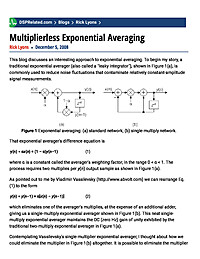
This blog discusses an interesting approach to exponential averaging. To begin my story, a traditional exponential averager (also called a "leaky integrator"), shown in Figure 1(a), is commonly used to reduce noise fluctuations that contaminate...
The correct answer to the quiz of @apolin
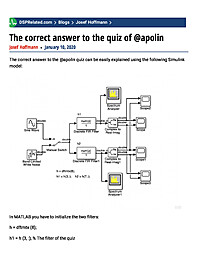
The correct answer to the @apolin quiz can be easily explained using the following Simulink model: In MATLAB you have to initialize the two filters: h = dftmtx (8); h1 = h (3, :); % The filter of the quiz h2 = h (7, :); % The...
Exploring Human Hearing Range
Human Hearing Range In this post, I'll look at an interesting aspect of Audacity – using it to explore the threshold of human hearing. In my book Digital Signal Processing: A Gentle Introduction with Audio Examples, I go into this topic...

Design Square-Root Nyquist Filters
In his book on multirate signal processing, harris presents a nifty technique for designing square-root Nyquist FIR filters with good stopband attenuation [1]. In this post, I describe the method and provide a Matlab function for designing the filters. You can find a Matlab function by harris for designing the filters at [2].
Linear Feedback Shift Registers for the Uninitiated, Part XVI: Reed-Solomon Error Correction
Last time, we talked about error correction and detection, covering some basics like Hamming distance, CRCs, and Hamming codes. If you are new to this topic, I would strongly suggest going back to read that article before this one. This time we...
Understanding and Preventing Overflow (I Had Too Much to Add Last Night)
Happy Thanksgiving! Maybe the memory of eating too much turkey is fresh in your mind. If so, this would be a good time to talk about overflow. In the world of floating-point arithmetic, overflow is possible but not particularly common. You can...
Launch of Youtube Channel: My First Videos - Embedded World 2017
I went to Embedded World 2017 in Nuremberg with an ambitious plan; I would make video highlights of several exhibits (booths) to be presented to the *Related sites audience. I would try to make the vendors focus their pitch on the essential...










