







Frequency Dependence in Free Space Propagation
IntroductionIt seems to be fairly common knowledge, even among practicing professionals, that the efficiency of propagation of wireless signals is frequency dependent. Generally it is believed that lower frequencies are desirable since pathloss...
Pulse Shaping in Single-Carrier Communication Systems
Some common conceptual hurdles for beginning communications engineers have to do with "Pulse Shaping" or the closely-related, even synonymous, topics of "matched filtering", "Nyquist filtering", "Nyquist pulse", "pulse filtering", "spectral...
Linear-phase DC Removal Filter
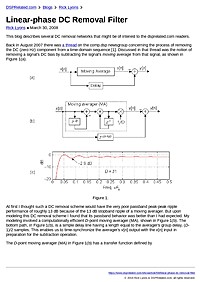
This blog describes several DC removal networks that might be of interest to the dsprelated.com readers. Back in August 2007 there was a thread on the comp.dsp newsgroup concerning the process of removing the DC (zero Hz) component from a...
Free DSP Books on the Internet
While surfing the "net" I have occasionally encountered signal processing books whose chapters could be downloaded to my computer. I started keeping a list of those books and, over the years, that list has grown to over forty books. Perhaps the...
Handling Spectral Inversion in Baseband Processing
The problem of "spectral inversion" comes up fairly frequently in the context of signal processing for communication systems. In short, "spectral inversion" is the reversal of the orientation of the signal bandwidth with...
An Interesting Fourier Transform - 1/f Noise
Power law functions are common in science and engineering. A surprising property is that the Fourier transform of a power law is also a power law. But this is only the start- there are many interesting features that soon become apparent. This may...
Spectral Flipping Around Signal Center Frequency
Most of us are familiar with the process of flipping the spectrum (spectral inversion) of a real signal by multiplying that signal's time samples by (-1)n. In that process the center of spectral rotation is fs/4, where fs is the signal's sample...
A Differentiator With a Difference
Some time ago I was studying various digital differentiating networks, i.e., networks that approximate the process of taking the derivative of a discrete time-domain sequence. By "studying" I mean that I was experimenting with various...
Delay estimation by FFT
Given x=sig(t) and y=ref(t), returns [c, ref(t+delta), delta)] = fitSignal(y, x);:Estimates and corrects delay and scaling factor between two signals Code snippet This article relates to the Matlab / Octave code snippet: Delay estimation with...
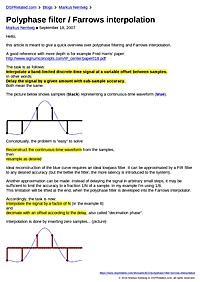
Polyphase filter / Farrows interpolation
Hello, this article is meant to give a quick overview over polyphase filtering and Farrows interpolation. A good reference with more depth is for example Fred Harris' paper: http://www.signumconcepts.com/IP_center/paper018.pdf The task is as...
Add a Power Marker to a Power Spectral Density (PSD) Plot
Perhaps we should call most Power Spectral Density (PSD) calculations relative PSD, because usually we don’t have to worry about absolute power levels. However, for cases (e.g., measurements or simulations) where we are concerned with...
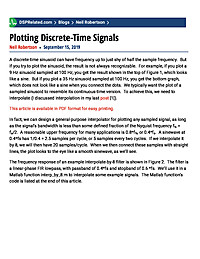
Plotting Discrete-Time Signals
A discrete-time sinusoid can have frequency up to just shy of half the sample frequency. But if you try to plot the sinusoid, the result is not always recognizable. For example, if you plot a 9 Hz sinusoid sampled at 100 Hz, you get the result shown in the top of Figure 1, which looks like a sine. But if you plot a 35 Hz sinusoid sampled at 100 Hz, you get the bottom graph, which does not look like a sine when you connect the dots. We typically want the plot of a sampled sinusoid to resemble its continuous-time version. To achieve this, we need to interpolate.
Hello and Introduction
Hello all.I would like to take this chance to talk a little about what I am going to try and do in this blog. While working in the field, I have come across some interesting techniques. It has, at times, taken some time and effort to understand...
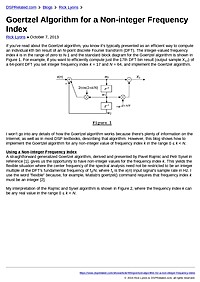
Goertzel Algorithm for a Non-integer Frequency Index
If you've read about the Goertzel algorithm, you know it's typically presented as an efficient way to compute an individual kth bin result of an N-point discrete Fourier transform (DFT). The integer-valued frequency index k is in the range of...
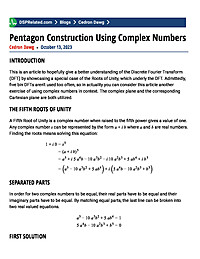
Pentagon Construction Using Complex Numbers
A method for constructing a pentagon using a straight edge and a ruler is deduced from the complex values of the Fifth Roots of Unity. Analytic values for the points are also derived.
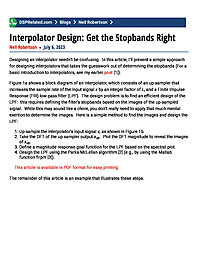
Interpolator Design: Get the Stopbands Right
In this article, I present a simple approach for designing interpolators that takes the guesswork out of determining the stopbands.
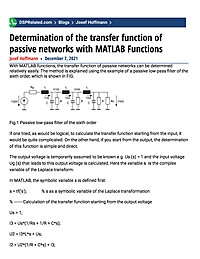
Determination of the transfer function of passive networks with MATLAB Functions
With MATLAB functions, the transfer function of passive networks can be determined relatively easily. The method is explained using the example of a passive low-pass filter of the sixth order, which is shown in FIG.Fig.1 Passive low-pass filter...
Polynomial calculations on an FIR filter engine, part 1
Polynomial evaluation is structurally akin to FIR filtering and fits dedicated filtering engines quite well, with certain caveats. It’s a technique that has wide applicability. This two-part note discusses transducer and amplifier non-linearity...

Adaptive Beamforming is like Squeezing a Water Balloon
Adaptive beamforming was first developed in the 1960s for radar and sonar applications. The main idea is that signals can be captured using multiple sensors and the sensor outputs can be combined to enhance the signals propagating from...
3 Good News
Good News #1 Last week, I announced a new and ambitious reward program that will be funded by the new Vendors Directory. This week, I am happy to announce that we have our firsts two sponsors! Quantum Leaps & Abelon Systems have...










